
No New Borrowing for New Economy Programme – Ato Forson
Finance Minister says the $13 billion four-year agenda will be funded through domestic revenue and fiscal restructuring, not fresh debt, as he prepares to present the 2027 Budget on Thursday. ACCRA…
Journalist
Published 4 min read
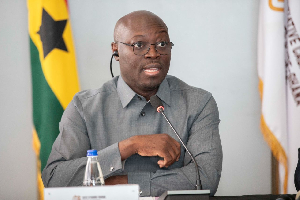
Finance Minister says the $13 billion four-year agenda will be funded through domestic revenue and fiscal restructuring, not fresh debt, as he prepares to present the 2027 Budget on Thursday.
ACCRA, Nov. 11 — Finance Minister Dr Cassiel Ato Forson has ruled out additional government borrowing to finance the proposed New Economy Programme, saying the initiative will rely on increased domestic revenue and savings from fiscal consolidation.
The programme is expected to receive an annual allocation equivalent to 1.5 per cent of Ghana's Gross Domestic Product from 2027 to 2030, with total funding projected to reach at least US$13 billion over the four-year period .
Speaking during an engagement with students and staff at the Kwame Nkrumah University of Science and Technology, Forson said the funding would be sourced through two fiscal measures: allocating 0.5 per cent of GDP from government revenue, and reducing the primary surplus target from 1.5 per cent to 0.5 per cent of GDP .
A primary surplus occurs when government revenue exceeds spending before interest payments on public debt are counted. Lowering the target would give the government more room to spend on the programme without contracting new loans .
Debt Trajectory
Forson maintained that the arrangement would create room for investment without undermining Ghana's debt sustainability commitments, including the target of reducing public debt to 45 per cent of GDP by 2028 .
He pointed to a primary surplus of 2.5 per cent of GDP in 2025 and a projected surplus of 1.5 per cent in 2026, which he said would contribute to reducing public debt by approximately four percentage points of GDP. From 2027, however, the government plans to slow the pace of debt reduction to 0.5 per cent of GDP annually to accommodate the New Economy investments .
The minister also clarified that the Ghana Gold Board does not generate revenue for the government, explaining that the state relies mainly on direct taxes, indirect taxes and non-tax revenue .
A Shift from Stabilisation to Production
The New Economy Programme represents a deliberate pivot in Ghana's economic strategy. After years of focusing on macroeconomic recovery under an IMF-supported programme, the government now aims to translate those gains into industrial growth and job creation .
The initiative targets nine priority sectors with high employment potential, including agriculture and agribusiness, textiles and garments, pharmaceuticals, tourism and manufacturing. A key objective is to move away from exporting raw materials toward local production and value addition, and to position Ghanaian businesses to take advantage of the African Continental Free Trade Area .
The 2027 Budget, themed "New Economy, New Ghana: Jobs and Prosperity," will be presented to Parliament on Thursday, November 12. Deputy Finance Minister Thomas Ampem Nyarko has said the budget will introduce no new taxes, with the government relying on savings from expenditure rationalisation and spending cuts to finance its flagship programmes .
Opposition Skepticism
The minority New Patriotic Party caucus has already raised questions about the financing plan. Ranking Member on the Finance Committee Dr Mohammed Amin Adam said the key issue was whether the government had demonstrated the capacity and financing to deliver on its existing commitments, citing under-execution of the 24-Hour Economy programme and other flagship initiatives .
He noted that only GH¢110 million was allocated to the 24-Hour Economy in the 2026 Budget against a projected US5.5 billion .
Background
Cassiel Ato Forson, a five-term MP for Ajumako Enyan Essiam and former Minority Leader, was appointed Finance Minister in January 2025. An economist and chartered accountant by training, he has overseen Ghana's completion of the US$3 billion IMF programme and a subsequent Policy Coordination Instrument to sustain macroeconomic stability .
Ghana's public debt stood at GH¢733.9 billion, or 45.9 per cent of GDP, as of July 2026, according to Bank of Ghana data, with domestic debt accounting for most of the recent increase . The government's ability to hold that trajectory while funding the New Economy Programme without new borrowing will be the central fiscal test of Thursday's budget.
---
The 2027 Budget Statement and Economic Policy will be presented to Parliament on Thursday, November 12.
Get the AfroAsia Media newsletter
The day's top stories from Africa and Asia, straight to your inbox.
Comments
0 comments
Loading…