
Bank of Ghana Governor and Queen Máxima Call for Shift from Financial Access to Financial Health
The Governor of the Bank of Ghana, Dr. Johnson Pandit Asiama, and Her Majesty Queen Máxima of the Netherlands have urged a fundamental rethinking of financial inclusion policy, arguing that simply…
Journalist
Published 4 min read
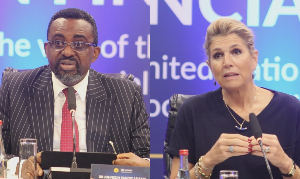
The Governor of the Bank of Ghana, Dr. Johnson Pandit Asiama, and Her Majesty Queen Máxima of the Netherlands have urged a fundamental rethinking of financial inclusion policy, arguing that simply providing people with bank accounts is no longer sufficient. The two leaders made the call on Wednesday at a high-level roundtable in Accra, stressing that the focus must now shift from mere financial access to measurable financial health.
Queen Máxima, who serves as the United Nations Secretary-General’s Special Advocate for Financial Health, is on a multi-day visit to Ghana to promote policies that help households and businesses build resilience rather than just transact. During the discussion at the Bank Square, she drew a sharp distinction between the two concepts.
“Financial access is a means to an end. Financial health is the end,” Queen Máxima said, explaining that while access refers to the ability to obtain services like accounts and credit, health concerns the actual benefits and security people derive from using them .
A Decade of Digital Growth, but Gaps Remain
In his remarks, Dr. Asiama acknowledged Ghana’s significant progress in expanding financial access. He noted that over the past decade, innovation and investment in digital infrastructure have positioned Ghana among Africa’s leading digital finance markets, with interoperable payment systems and mobile money bringing services to millions .
However, the Governor conceded that access alone has not translated into widespread prosperity. “Access to financial services alone is not enough,” Dr. Asiama said, stressing that the conversation must now focus on whether that access actually leaves households and businesses in better financial shape .
The data underscores the challenge. According to the World Bank’s Global Findex Database 2025, approximately 81 percent of Ghanaian adults hold a financial account. Yet a 2021 FinScope survey found that only 22 percent of adults were financially healthy, while 34 percent remained financially vulnerable .
Productive Credit as a Pathway
Dr. Asiama identified productive and responsible credit as a critical pathway to improving financial health, particularly for micro, small, and medium-sized enterprises (MSMEs), which he described as the backbone of Ghana’s economy.
He noted that many viable businesses still face unfair barriers in accessing finance. “Credit is unavailable to businesses with the potential simply because of unfair mechanisms,” he said, calling for greater use of technology and data to bridge information gaps and create fair financing opportunities for MSMEs, women, and smallholder farmers .
The Four Pillars of Financial Health
Queen Máxima outlined a practical framework for financial health, defining it through four dimensions: managing day-to-day finances, having liquidity to bridge temporary gaps, building resilience against shocks like illness or climate events, and planning for the future through savings and pensions .
She emphasized that financial health is not just a social good but an economic imperative. “It makes business sense and it’s good for the stability of the country,” she said, noting that employers lose productivity when workers are distracted by financial stress, and that financial providers who invest in customer well-being become profitable faster than expected .
The Queen also pointed to a significant gap in Ghana’s long-term savings landscape, noting that insurance penetration remains only about three percent of GDP. She urged financial institutions to move beyond short-term transactions and develop longer-term products, including pensions and insurance schemes tailored to the needs of informal sector workers .
A Broader Visit
The roundtable was part of Queen Máxima’s broader visit to Ghana, which included stops at agribusinesses in the Upper West Akim District and meetings with fintech entrepreneurs and healthcare providers. Her itinerary highlighted practical innovations in financial health, from crop insurance for tomato farmers to apps that help market women build credit histories while saving .
The Bank of Ghana has signaled its commitment to moving the agenda forward. Dr. Asiama called for sustained collaboration across government, regulators, industry, and development partners to ensure that financial access translates into tangible improvements in living conditions and business growth.
“These questions require partnership,” he said, urging participants to move from discussion to action with clear priorities and concrete commitments .
Get the AfroAsia Media newsletter
The day's top stories from Africa and Asia, straight to your inbox.
Comments
0 comments
Loading…