
نعمل الآن على ترجمة هذا المقال إلى العربية — ستظهر الترجمة هنا بعد لحظات. نعرض لك في الأثناء النص الأصلي باللغة الإنجليزية.
Ghana’s economic recovery gains momentum as inflation eases, BoG Governor declares
The Governor of the Bank of Ghana (BoG), Dr Johnson Pandit Asiama, has delivered a buoyant assessment of the nation’s economic trajectory, declaring that Ghana’s positive prospects are firmly anchored in the continued decline of inflation and robust growth across key sectors. Speaking at a stakeholder engagement and dinner meeting in Sunyani, Bono Region, Dr…
بقلم Ralph Waldo Emerson
نُشر في مدة القراءة: 7 د
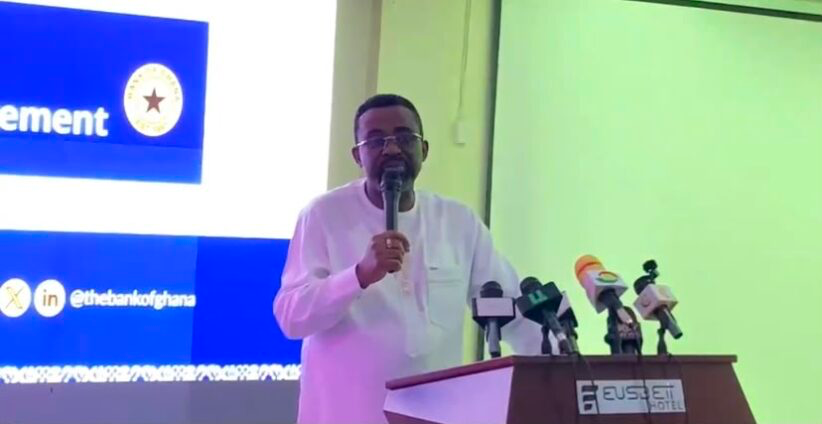
The Governor of the Bank of Ghana (BoG), Dr Johnson Pandit Asiama, has delivered a buoyant assessment of the nation’s economic trajectory, declaring that Ghana’s positive prospects are firmly anchored in the continued decline of inflation and robust growth across key sectors.
Speaking at a stakeholder engagement and dinner meeting in Sunyani, Bono Region, Dr Asiama told an audience of entrepreneurs, business leaders, traders, and trade association representatives that the macroeconomic environment is showing clear signs of stabilisation after years of turbulence.
“The economy grew by an estimated 6.4 per cent in the first quarter of 2026, compared with 6.2 per cent recorded during the same period in the previous year,” Dr Asiama revealed, citing preliminary data that underscores the resilience of Ghana’s productive base.
Growth Drivers: Services and Industry Lead the Charge
The Governor attributed the accelerated growth primarily to robust performance in the services and industrial sectors, which together account for the lion’s share of Ghana’s economic output. The services sector, buoyed by a revival in hospitality, retail trade, and financial services, has emerged as the single largest contributor to GDP expansion.
Industrial production, meanwhile, has benefited from improved power supply stability, a gradual recovery in manufacturing, and the resumption of large-scale construction projects that had been delayed during the height of the fiscal crisis.
“The economy has remained resilient and continues to show strong performance, with key macroeconomic indicators remaining stable,” Dr Asiama affirmed, pointing to the consistency of the central bank’s monetary policy framework as a key anchor for this stability.
A Tale of Two Numbers: Inflation Declines as Confidence Rises
The Governor’s optimism is underpinned by a significant easing of inflationary pressures, which had soared to over 50 per cent during the 2022–2023 crisis. Although Dr Asiama did not cite a specific current inflation figure in his remarks, recent data from the Ghana Statistical Service indicates that headline inflation has continued its downward trajectory, hovering in the mid-to-high teens—a marked improvement that has restored purchasing power and consumer confidence.
“Businesses and consumers are becoming more confident about the future,” Dr Asiama noted, adding that lending rates had declined, making credit more accessible to firms seeking to expand operations. This easing of financing conditions is expected to further stimulate private sector investment and job creation.
Tourism Revival and Business Activity Surge
The Governor expressed particular enthusiasm about the resurgence of tourism, which had been decimated by the COVID-19 pandemic and subsequent economic downturn.
“In fact, we are seeing more and more people visiting and touring Ghana, and it helps to support economic activity,” he said. The recovery of the tourism sector—which supports thousands of jobs in hospitality, transport, and retail—is seen as a bellwether for broader economic normalisation.
Alongside tourism, Dr Asiama highlighted increasing business and trade activities, industrial production, and the broader recovery of domestic commerce as signs that the private sector is regaining its dynamism.
Resilience of the Cedi and External Sector
Although the Governor focused primarily on growth and inflation, the stability of the Ghanaian cedi against major currencies has been another pillar of the current economic recovery. After suffering severe depreciation in 2022 and 2023, the currency has shown relative stability in 2026, supported by improved foreign exchange inflows from gold exports, cocoa sales, and remittances, as well as the resumption of disbursements under the IMF-backed programme.
Cautionary Note: Ghana’s Vulnerability to Global Shocks
Despite the encouraging domestic picture, Dr Asiama struck a cautious note, warning that Ghana’s status as a “small open economy” leaves it acutely exposed to external developments.
“We are a small open economy, and that means that we are subject to anything that happens in the world, whether we are part of it or not,” he cautioned.
As a concrete example, the Governor cited the ongoing tensions between Iran and the United States—a geopolitical flashpoint that, while geographically distant, has ripple effects on global oil prices. Since Ghana is a net importer of petroleum products, rising crude prices directly translate into higher fuel costs, which in turn push up domestic transport and production costs.
“The impact of conflicts in the Middle East, particularly through rising oil prices, continues to affect the economy,” Dr Asiama said, noting that such external shocks remain a persistent risk to the country’s stability.
Acknowledging the IMF’s Role and Domestic Policy Coordination
Dr Asiama’s remarks implicitly acknowledged the critical role played by the International Monetary Fund’s $3 billion Extended Credit Facility programme, which has provided fiscal space and policy discipline necessary for the current recovery. The programme’s strict performance criteria—covering deficit reduction, debt restructuring, and monetary tightening—have forced the government to make difficult choices, but the results are now beginning to manifest in improved confidence and growth metrics.
The Governor also praised the coordination between the central bank and the Ministry of Finance, which he said had been essential in maintaining policy coherence and investor confidence.
Demystifying the Central Bank: A Bid for Transparency
Beyond the economic data, Dr Asiama used the Sunyani engagement to highlight the Bank of Ghana’s commitment to transparency and stakeholder engagement. He explained that the event was part of a broader effort to demystify the central bank’s operations and enhance its credibility with the public.
“We want to build stronger relationships with stakeholders and ensure that our policies respond to the needs of businesses and, of course, the people that we serve,” he stated.
This outreach initiative is significant because the central bank has historically been viewed by many Ghanaians as a distant, opaque institution. By engaging directly with small business owners, traders, and trade associations in regional capitals like Sunyani, the BoG is seeking to foster greater understanding of its mandate and build trust in its policy decisions.
What This Means for Ghana’s Economic Future
The Governor’s assessment paints a picture of an economy that has turned the corner after one of the most severe crises in its recent history. The combination of falling inflation, rising GDP growth, and declining lending rates creates a virtuous cycle: lower inflation boosts household purchasing power, higher growth generates employment and tax revenues, and lower interest rates encourage business investment.
However, the path ahead is not without obstacles. The looming maturity wall from the Domestic Debt Exchange Programme—which the IMF recently warned could push gross financing needs above 16 per cent of GDP in 2028—remains a structural challenge. Furthermore, as Dr Asiama acknowledged, Ghana cannot insulate itself from global volatility, whether from Middle Eastern conflicts, shifts in commodity prices, or changes in global financial conditions.
A Message of Reassurance and Determination
In closing, the BoG Governor reaffirmed the central bank’s unwavering commitment to price stability, support for businesses, and the promotion of inclusive growth.
“The economy continues to perform appreciably well,” he insisted, while underscoring that the central bank remains focused on strengthening Ghana’s resilience to both domestic and external challenges.
For the entrepreneurs and business owners in attendance at the Sunyani event, the Governor’s message was one of reassurance: the worst of the crisis has passed, and with continued discipline and cooperation, Ghana’s recovery can be sustained.
Conclusion
Dr Asiama’s remarks in Sunyani represent the most authoritative confirmation to date that Ghana’s economic stabilisation is gaining traction. With inflation trending downward, growth accelerating, and confidence returning to the business community, the country appears to be emerging from the shadows of debt distress. Yet the Governor’s caution about global vulnerability serves as a sobering reminder that in an interconnected world, no economy—especially one as open as Ghana’s—can afford to rest on its laurels.
The Bank of Ghana’s stakeholder engagement initiative, meanwhile, signals a welcome shift towards greater transparency and inclusivity in monetary policy communication, which will serve the country well as it navigates the next phase of its recovery journey.
The Bank of Ghana has not yet released the full first-quarter GDP figures for 2026, but Dr Asiama’s preliminary estimate of 6.4 per cent growth suggests the economy is outperforming earlier projections.
شارك هذا الخبر
اشترك في النشرة الإخبارية لـ AfroAsia Media
أبرز أخبار اليوم من أفريقيا وآسيا، مباشرةً إلى بريدك الإلكتروني.




التعليقات
عدد التعليقات: 0
جارٍ التحميل…