
نعمل الآن على ترجمة هذا المقال إلى العربية — ستظهر الترجمة هنا بعد لحظات. نعرض لك في الأثناء النص الأصلي باللغة الإنجليزية.
Ghana moves to reclaim Kpeshie Lagoon: Government orders ecological restoration after demolition of illegal structures
The government has launched an ambitious ecological restoration of the Kpeshie Lagoon after demolishing illegal structures within the wetland’s protected buffer zone, in a decisive move to reclaim one of Accra’s most degraded natural flood-control systems. Deputy Chief of Staff, Operations, Stan Xoese Dogbe, has directed the Greater Accra Regional Coordinating Council (GARCC) to begin…
بقلم Ralph Waldo Emerson
نُشر في مدة القراءة: 5 د
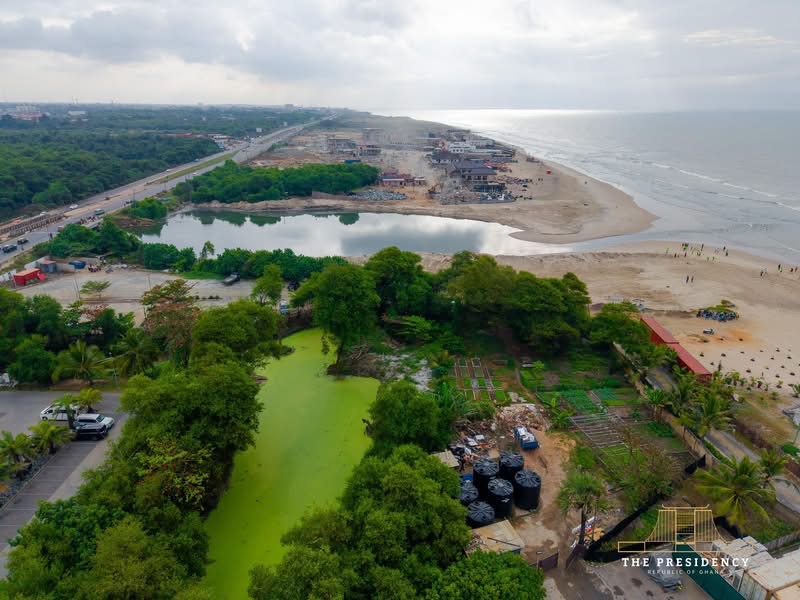
The government has launched an ambitious ecological restoration of the Kpeshie Lagoon after demolishing illegal structures within the wetland’s protected buffer zone, in a decisive move to reclaim one of Accra’s most degraded natural flood-control systems.
Deputy Chief of Staff, Operations, Stan Xoese Dogbe, has directed the Greater Accra Regional Coordinating Council (GARCC) to begin the restoration exercise, which will involve the Forestry Commission and the Environmental Protection Authority (EPA). The plan includes planting coconut trees and other suitable vegetation, alongside environmental safeguards to rehabilitate the fragile ecosystem.
The directive was issued at Laboma following a demolition exercise by the Post Flood Mitigation Task Force, as part of ongoing measures to restore flood-control infrastructure and protect critical water retention areas across Greater Accra.
A Wetland Destroyed by Decades of Encroachment
The Kpeshie Lagoon, situated between the Teshie Rasta Road corridor and the Ghana International Trade Fair corridor, was once a thriving wetland ecosystem covering a catchment area of roughly 110 square kilometers and occasionally joining the Atlantic Ocean. In the 1960s, it functioned as a critical natural flood control system with functional drainage infrastructure, supporting aquatic biodiversity and providing resources for local livelihoods.
That ecological heritage has been systematically dismantled. Private developers, operating with what authorities describe as impunity, cleared mangrove vegetation, dumped heavy boulders into the water body, and covered the area with sand and other fill materials to create artificial land for residential and commercial development.
Greater Accra Regional Minister Linda Ohenewaa Akweley Ocloo, who supervised the demolition, described the transformation starkly: “Everybody knows Laboma. All this place used to be mangrove. It’s a wetland and that’s the sea. They cut the trees, filled this place and sold the land to developers, including businesses, to build hotels and other things.”
The consequences have been severe. The reclamation and sand filling significantly reduced the lagoon’s natural water-holding capacity, directly contributing to flooding in surrounding communities. The Regional Minister revealed that a government risk assessment established a link between the conversion of the lagoon’s floodplain and flooding recorded in the Tse Addo area during recent heavy rains.
From Demolition to Restoration
The demolition exercise, carried out by the 48 Engineer Regiment under the Post Flood Mitigation Task Force, followed a 21-day ultimatum issued to occupants of the affected area. A newly constructed wall along the Labadi-Teshie road was also demolished after authorities found that vegetation had been cleared and the area was being filled with solid materials.
Mr. Dogbe, a former journalist who served as Head of Talk Programmes at Joy FM before his appointment as Deputy Chief of Staff (Operations) in January 2025, emphasized that the objective extends beyond mere clearance.
“The objective is not simply to clear the area, but to return the reclaimed sections to their natural state, strengthen the lagoon’s capacity to retain floodwaters and prevent future encroachment,” he stated.
The restoration phase will involve the Forestry Commission, which has a statutory mandate to manage forest and wildlife resources and undertake the development of forest plantations for the restoration of degraded areas. The Environmental Protection Authority, established with expanded regulatory powers under the Environmental Protection Act of 2025, will provide compliance oversight and environmental monitoring.
The choice of coconut trees and other suitable species aligns with the Forestry Commission’s broader reforestation initiatives across Ghana. The Commission has previously emphasized that tree planting represents only the first step, with long-term success dependent on proper aftercare, including regular watering and protection of seedlings.
Part of a Broader Flood Mitigation Strategy
The Kpeshie intervention is one component of a multi-location flood mitigation exercise being conducted across the Greater Accra Region. The Task Force has already conducted operations at the Tesa Dam and Legon Boundary Road watercourse, where illegal retaining walls and unauthorized structures were demolished after residents received three weeks’ notice.
At the Lafa Water Retention Basin in Mallam, the 48 Engineer Regiment deployed six excavators, two wheel loaders, and a long boom machine to remove compacted solid waste that had severely reduced the basin’s capacity. Debris was transported to a designated landfill at Nsawam with support from Zoomlion Ghana Limited.
The broader programme combines demolition, dredging, and restoration of retention basins to improve stormwater flow and reduce flood risks across the capital.
The Road Ahead
With the clearance phase now underway at Kpeshie, authorities will move toward debris removal, vegetation restoration, and sustained environmental protection. The challenge, however, extends beyond physical rehabilitation. As one analysis of the lagoon’s plight noted, the absence of proper waste interception systems allows domestic waste, industrial runoff, and untreated effluents to continue flowing into the water body, degrading water quality and diminishing its ability to support biodiversity.
The success of the restoration will ultimately depend on whether enforcement measures can prevent the cycle of re-encroachment that has plagued the lagoon for decades. Authorities say similar exercises will continue at identified flood-prone locations across the Greater Accra Region, signaling a sustained commitment to protecting the city’s remaining natural water retention systems.
Key Facts at a Glance:
· Location: Kpeshie Lagoon, Laboma, Greater Accra Region
· Directive Issued By: Stan Xoese Dogbe, Deputy Chief of Staff, Operations
· Implementing Agencies: GARCC, Forestry Commission, EPA
· Lead Enforcement Body: Post Flood Mitigation Task Force (48 Engineer Regiment)
· Restoration Plan: Coconut tree planting, vegetation restoration, environmental safeguards
· Primary Objective: Restore lagoon’s floodwater retention capacity and prevent future encroachment
شارك هذا الخبر
اشترك في النشرة الإخبارية لـ AfroAsia Media
أبرز أخبار اليوم من أفريقيا وآسيا، مباشرةً إلى بريدك الإلكتروني.




التعليقات
عدد التعليقات: 0
جارٍ التحميل…