
Ghana's Communications Minister Clarifies Distinction Between 24-Hour Economy and New Economy, Opposition Calls It "Repackaging"
As Ghana's government rolls out two major economic initiatives, the Minister of State for Government Communications has stepped forward to clarify the fundamental differences between the two, amid…
Journalist
Published 4 min read
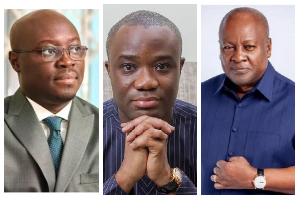
As Ghana's government rolls out two major economic initiatives, the Minister of State for Government Communications has stepped forward to clarify the fundamental differences between the two, amid opposition accusations that the newly launched "New Economy" programme is merely a rebranding of the previously implemented "24-Hour Economy" policy.
Two Initiatives, Different Logics
In an interview with Joy News ahead of the 2027 Budget presentation on November 12, Felix Ofosu Kwakye, Minister of State for Government Communications and Member of Parliament for Abura-Asebu-Kwamankese, explained that although the two programmes overlap in some areas, their objectives, implementation methods, and scope differ fundamentally .
He pointed out that the 24-Hour Economy is primarily a private sector-led initiative aimed at encouraging businesses to extend operating hours and adopt shift systems through government incentives, thereby expanding business activities and creating more jobs. "The 24-hour economy, although a government initiative, is primarily directed at the private sector," Ofosu Kwakye said. "The government believes this economy can operate without sleep, running around the clock. To achieve this, we need to provide incentives to private companies, allowing them to seize the opportunity, expand their businesses, and hire more people in the process" .
He disclosed that approximately 33 major private enterprises have registered with the 24-Hour Economy Secretariat, with some already implementing the initiative ahead of the government's announcement of specific incentives. He cited the Ghana Ports and Harbours Authority (GPHA), which introduced a shift system allowing customers to clear goods at night, resulting in the employment of an additional 1,400 workers; and Ghana Publishing Company Limited, which retained 100 workers who would otherwise have been laid off by introducing a shift system .
New Economy: A $10 Billion Structural Transformation Plan
Regarding the New Economy programme, Ofosu Kwakye described it as a long-term government initiative focused on restructuring Ghana's economy through strategic investment in selected growth sectors. The programme will allocate $10 billion to finance specific growth pillars, with the goal of transforming the economy from dependence on raw materials to a value-added economy capable of creating sustainable quality jobs .
"The New Economy is a multi-year government programme through which $10 billion will be set aside to finance specific growth pillars, transform the structure of our economy, make us a value-added economy, and ensure quality jobs for Ghanaians in the process," he stated. He added that the programme is also designed to break Ghana's cycle of recurring economic crises and repeated recourse to IMF assistance .
According to the 2027 Budget Statement presented by Finance Minister Dr. Cassiel Ato Forson, the New Economy programme will run from 2027 to 2030, identifying eight priority areas including macroeconomic stability and affordable financing, commercial agriculture, energy infrastructure, value addition to critical minerals, tourism and creative arts, textiles and garments, pharmaceuticals and biomanufacturing, and the technology economy . The government plans to finance the programme through retained primary surplus and enhanced revenue measures, rather than new external borrowing .
Opposition's Doubts: "Old Wine in New Bottles"
However, the opposition has expressed strong skepticism about this. Dr. Mohammed Amin Adam, Ranking Member on Parliament's Finance Committee, argued at a press conference that six of the eight pillars of the New Economy programme were already contained in the 24-Hour Economy framework. He called the New Economy "dead on arrival and full of deception," saying it "promises jobs in 2030 when young people need jobs now" .
Dr. Amin Adam also questioned the government's ability to raise the estimated $10 billion, noting that the government had previously failed to raise the projected $4 billion needed for the 24-Hour Economy. He further pointed out that while the government claimed it would not borrow for the New Economy, the 2027 Budget projected GH¢85 billion in domestic borrowing .
Economist Dr. George Domfeh also stated on Asempa FM that the government was "fleeing" from the 24-Hour Economy policy and simply rebranding its core proposals as the New Economy. "The NDC is fleeing from the 24-Hour Economy," he said. "All the issues raised about the 24-Hour Economy have simply been rebranded as the New Economy. There is nothing new" .
Government's Response and Budget Reality
Ofosu Kwakye emphasized that the two initiatives should not be confused: the 24-Hour Economy primarily stimulates private sector activity through incentives, while the New Economy is a long-term government investment strategy. The 2027 Budget confirms this positioning—the government has allocated GH¢30 billion to the New Economy programme, while the 24-Hour Economy Secretariat receives only GH¢165 million .
The 24-Hour Economy has already been enshrined in law. In February 2026, Parliament passed the 24-Hour Economy Authority Bill, and President Mahama signed it into law, with the government committing GH¢110 million in the 2026 Budget to kickstart the initiative . The New Economy programme, meanwhile, is positioned as the next phase of economic transformation following the completion of economic stabilization—from restoring macroeconomic stability to structural transformation and industrialization.
For ordinary Ghanaians, the key question is not the conceptual distinction between the two initiatives, but whether either can deliver on the promise of "jobs and prosperity." The New Economy's goal of reducing unemployment below 8% by 2030, as set out in the budget, will be the ultimate test of this debate.
Get the AfroAsia Media newsletter
The day's top stories from Africa and Asia, straight to your inbox.
Comments
0 comments
Loading…