
我们正在将本文翻译成中文,译文稍后将显示在此处。目前先显示英文原文。
Sportsmanship or oversight? Messi and Mac Allister’s silence spares Rice from Prestianni Law red card
In the white-hot cauldron of a World Cup semi-final, with England and Argentina locked in a battle for a place in Sunday’s showpiece, an extraordinary act of sportsmanship — or perhaps a costly oversight — may have spared England midfielder Declan Rice from becoming the third player sent off under FIFA’s controversial new “Prestianni Law.”…
发布于 阅读约 4 分钟
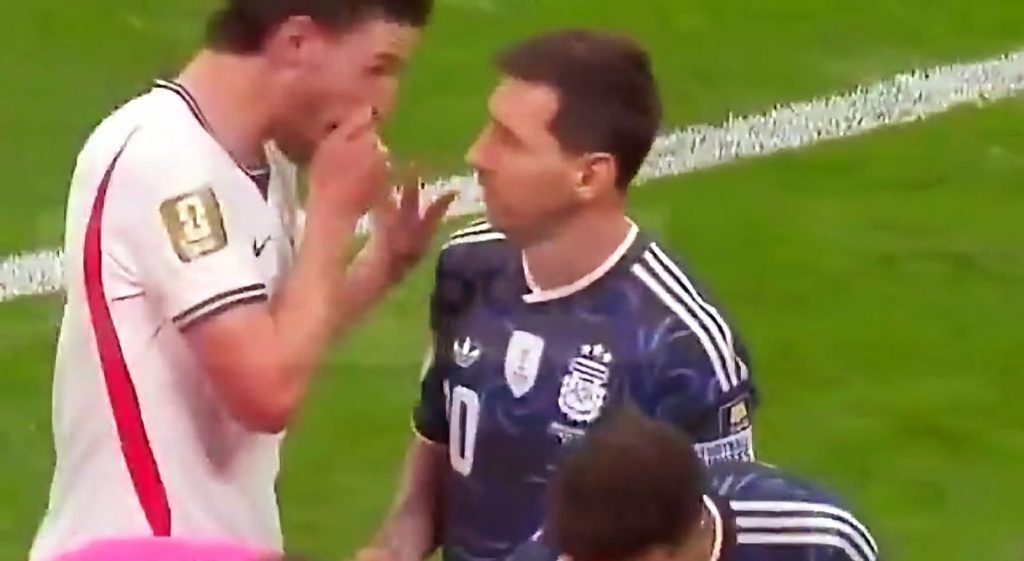
In the white-hot cauldron of a World Cup semi-final, with England and Argentina locked in a battle for a place in Sunday’s showpiece, an extraordinary act of sportsmanship — or perhaps a costly oversight — may have spared England midfielder Declan Rice from becoming the third player sent off under FIFA’s controversial new “Prestianni Law.”
Argentina came from behind to snatch a dramatic 2-1 victory at the Atlanta stadium, with Enzo Fernández equalising in the 85th minute before Lautaro Martínez headed home a Lionel Messi cross deep into stoppage time. But the post-match headlines have been dominated not by the goals, but by a moment early in the first half that could have altered the course of the match entirely.
The incident
Following a foul on England’s Elliot Anderson in the 37th minute — one of 19 fouls committed in a fractious first half — players from both sides converged in the middle of the pitch. As tempers flared, Rice was captured on camera engaging in tense exchanges with Lionel Messi, Enzo Fernández, and Alexis Mac Allister. On three separate occasions during these confrontations, the Arsenal midfielder was seen deliberately covering his mouth with his hand while directing words toward his opponents.
Under FIFA’s newly enacted “Prestianni Law” — introduced specifically for this World Cup — any player who deliberately covers their mouth while addressing an opponent during a confrontation can be shown a direct red card. The rule was designed to prevent players from concealing abusive, discriminatory, or offensive language on the field.
The law that changed the game
The regulation, nicknamed the “Prestianni Law” by fans, was rushed in following a Champions League incident earlier this year involving Benfica winger Gianluca Prestianni and Real Madrid’s Vinícius Júnior. Prestianni raised his shirt to cover his mouth while speaking to Vinícius, who alleged he was racially abused. Because Prestianni’s mouth was covered, it was impossible to review footage to verify what was actually said. Following a UEFA investigation, Prestianni was found guilty of homophobic conduct and handed a six-match ban — three of which were suspended.
FIFA president Gianni Infantino pushed for the rule change, wanting something that would have “a deterrent effect” at the World Cup. The law has already been enforced twice in the tournament: Paraguay’s Miguel Almirón became the first player ever sent off for covering his mouth, followed by Ecuador’s Piero Hincapié in the round of 16.
Sportsmanship that saved Rice
Yet when Rice committed the same offence, no red card followed. The reason? None of the Argentina players reported it.
According to multiple reports, neither Messi nor any other Argentina player present — including Fernández and Mac Allister — appeared to notice Rice’s gesture, or chose not to draw the referee’s attention to it. Crucially, none complained to referee Ismail Elfath or requested a VAR review. The match officials did not spot the infringement, and VAR apparently did not flag it either.
The contrast with events elsewhere on the pitch was stark. Earlier in the same half, Argentina midfielder Leandro Paredes had been branded “pathetic” by critics after he attempted to convince officials that England captain Harry Kane should be sent off for briefly covering his mouth while speaking to the referee. Crucially, however, the Prestianni Law applies to confrontations between players — not conversations with match officials — meaning Kane’s gesture fell outside its scope.
A rule shrouded in confusion
The Prestianni Law has proved deeply controversial throughout the tournament. Critics argue it presumes guilt rather than innocence, and there have been concerns it could be weaponised by players seeking to get opponents sent off when nothing abusive has actually been said. The rule has also caused confusion — England’s Jude Bellingham was not sent off for covering his mouth in conversation with Ghana’s Jordan Ayew during the group stage.
Adding to the complexity, UEFA has confirmed it will not adopt the rule for its own competitions, with European football’s governing body stating that referees should assess situations individually and consider whether a yellow card is more appropriate.
What now for Rice?
FIFA has yet to announce any investigation into Rice’s actions, meaning the 27-year-old is likely to be available for England’s third-place play-off against France on Saturday. No retrospective punishment is expected.
For Argentina, the focus now shifts to Sunday’s final against Spain. Messi, who provided two assists in the dying minutes to turn the match on its head, has once again demonstrated why he is widely regarded as the game’s greatest — not just for his genius with the ball, but, on this occasion, for the grace he showed in not pursuing a punishment that could have changed everything.
Whether that grace was intentional or simply a case of not noticing, it may well have been the moment that kept England in the match far longer than they might otherwise have remained.
订阅 AfroAsia Media 新闻简报
每日非洲与亚洲要闻,直接发送到您的邮箱。




评论
0 条评论
加载中…