
我们正在将本文翻译成中文,译文稍后将显示在此处。目前先显示英文原文。
FIFA referees chief Collins defends VAR decision to disallow Egypt goal against Argentina
In a detailed and robust defense of match officials, FIFA Head of Referees Pierluigi Collina has publicly explained the rationale behind the contentious decision to disallow Egypt’s goal against Argentina in their recent high-profile clash, after a lengthy Video Assistant Referee (VAR) review. The decision, which sparked outrage among Egyptian supporters and players, hinged on…
发布于 阅读约 3 分钟
In a detailed and robust defense of match officials, FIFA Head of Referees Pierluigi Collina has publicly explained the rationale behind the contentious decision to disallow Egypt’s goal against Argentina in their recent high-profile clash, after a lengthy Video Assistant Referee (VAR) review.
The decision, which sparked outrage among Egyptian supporters and players, hinged on a minor infraction deep in the attacking build-up phase—a moment of contact that occurred several passes before the ball hit the back of the net. Speaking to reporters, Collina laid out the strict protocols that govern VAR intervention, emphasizing that no phase of play is exempt from scrutiny.
The VAR Protocol: No “Statute of Limitations”
“After every goal, the VAR automatically checks the entire attacking possession phase that led to the score,” Collina stated. “There is no limit on the distance from the goal or the time elapsed between the incident and the goal. If a violation is found in the build-up and that violation directly impacts the goal, the referee is advised to conduct an on-field review.”
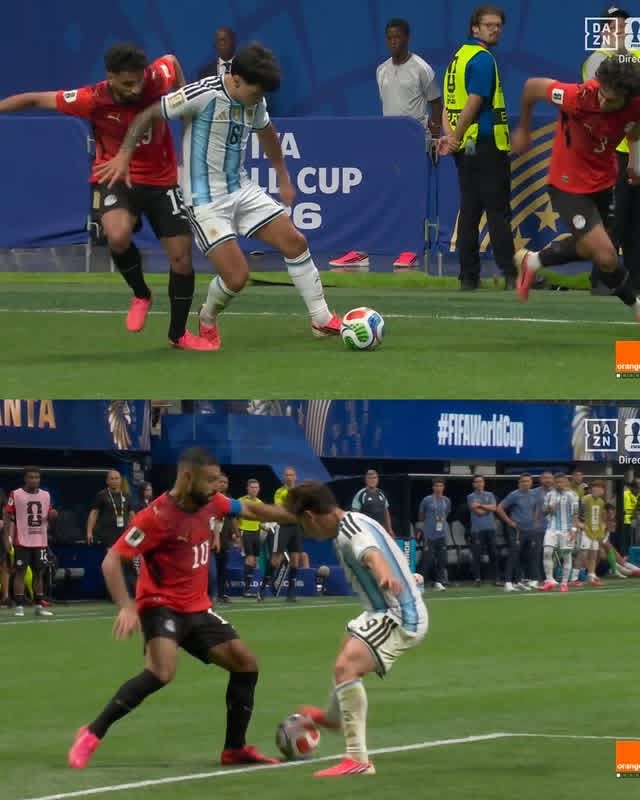
The Egyptian goal was initially celebrated wildly, but the celebrations were cut short when the referee was summoned to the pitch-side monitor. The review pinpointed a moment in the middle of the park where Egypt midfielder Marwan Attia challenged Argentina defender Lisandro Martínez.
The Decisive Foul: A Clear “Step”
Collina was unequivocal about the nature of the infringement. “Marwan Attia clearly stepped on Lisandro Martínez’s foot. A violation is a violation,” he asserted. “If the referee misses it on the field, VAR can intervene. If no offence is detected in the attacking build-up, VAR confirms the goal. In this instance, the contact was clear and affected the defender’s ability to recover.”
The FIFA chief preempted criticism that the contact was minimal, clarifying the fine line between a foul and acceptable physical play. “Stepping on an opponent’s foot is a foul,” he reiterated. “However, we must differentiate between a deliberate stamp and natural football contact. When a defender wins the ball first and the subsequent contact is incidental and natural, it may not be a violation. In this case, the contact was not incidental; it was a clear step on the foot that impeded the player.”
The Salah-Álvarez Incident: A Matter of Judgment
Collina also addressed a second, late-game flashpoint involving Mohamed Salah and Argentina’s Julián Álvarez, which occurred near the Egyptian penalty area. Unlike the disallowed goal, this incident did not result in a penalty or VAR intervention.
“Regarding the late incident involving Mohamed Salah and Julián Álvarez, this was considered natural football contact by both the referee and the VAR team,” Collina explained. “The defender was making a legitimate play for the ball, and the contact that followed was deemed within the acceptable parameters of the game.”
He acknowledged that not every decision is black and white, conceding the inherent subjectivity of officiating. “There will always be an element of personal judgement in some decisions. While the rules are clear on stepping on a foot, the intensity, intent, and context of every challenge are unique. We are pleased with how this principle has been applied consistently throughout the tournament,” he added.
Reaction and Aftermath
The explanation comes as Argentina’s players expressed relief, while the Egyptian camp, led by their coaching staff, remained visibly frustrated, arguing that the initial foul was too far back in the play to warrant overturning a goal. Despite the controversy, Collina’s firm stance underscores FIFA’s commitment to a zero-tolerance policy on fouls in the build-up phase, regardless of where they occur on the pitch.
The decision has reignited debate over the VAR’s role in dissecting every millisecond of a move, but for now, the result stands, with the governing body backing its officials’ adherence to the letter of the law.
订阅 AfroAsia Media 新闻简报
每日非洲与亚洲要闻,直接发送到您的邮箱。




评论
0 条评论
加载中…