
我们正在将本文翻译成中文,译文稍后将显示在此处。目前先显示英文原文。
Collins wades into red-card debate, defends Messi challenge while condemning Palogun tackle
FIFA Referees Committee Chairman Pierluigi Collina has sparked fresh debate over officiating standards after drawing a sharp distinction between a recent challenge by Lionel Messi and a separate incident involving a player identified as “Palogun,” insisting the former was never a red-card offence while the latter warranted an automatic dismissal. In an exclusive interview with…
发布于 阅读约 4 分钟
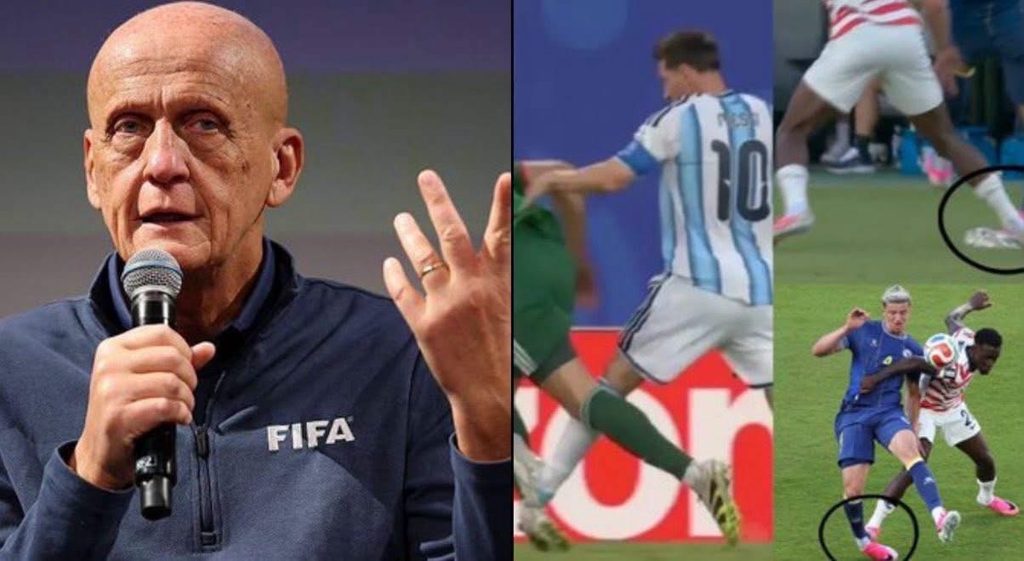
FIFA Referees Committee Chairman Pierluigi Collina has sparked fresh debate over officiating standards after drawing a sharp distinction between a recent challenge by Lionel Messi and a separate incident involving a player identified as “Palogun,” insisting the former was never a red-card offence while the latter warranted an automatic dismissal.
In an exclusive interview with Italian sports daily La Gazzetta dello Sport published on Thursday, the legendary former referee offered his technical analysis of two high-profile tackles that have dominated social media discourse in recent weeks. Collina, who oversees global refereeing standards and training, used the comparison to educate fans on the nuanced criteria for serious foul play.
Messi challenge: ‘Unintentional and without follow-through’
Collina addressed the Messi incident first, referring to a challenge made by the Argentine captain during Inter Miami’s recent CONCACAF Champions Cup clash against Monterrey. Messi was shown a yellow card for a late tackle on an opponent’s ankle, but many fans and pundits had called for a red, citing the dangerous nature of the contact.
“Messi’s challenge was never the type that deserves a red card,” Collina said emphatically. “It was unintentional. He attempted to play the ball, his foot made contact with the opponent’s ankle, but he did not keep his foot on the ankle after the contact occurred. The lack of follow-through is a crucial factor – it indicates the player’s action was not reckless or excessive force.”
Collina noted that under Law 12 of the Laws of the Game, a red card requires “serious foul play,” which is defined by excessive force or brutality. “The Messi challenge simply does not meet that threshold. The referee’s decision to issue a yellow card was correct, and the VAR review properly upheld it.”
Palogun tackle: ‘A very dangerous twist’
Contrasting that, Collina turned to the “Palogun incident” – a tackle that occurred in a recent African club competition match, in which a defender lunged in from behind, causing the opponent’s ankle to twist violently under his weight. The tackle resulted in a fractured fibula for the victim, and the referee on the day issued only a yellow card, sparking outrage among players and coaches.
“The Palogun incident is completely different,” Collina stated. “The way the player’s ankle twisted was very dangerous. There was clear excessive force, the contact was made with the studs exposed, and the momentum of the challenge carried through the opponent’s leg. If I were the referee, I would have shown a red card without hesitation.”
He added that VAR should have intervened to upgrade the yellow to red, as the tackle met the criteria for serious foul play. “This is precisely the kind of challenge that the protocols are designed to catch – one that endangers the opponent’s safety and shows a blatant disregard for the risk of injury.”
Fans and social media: ‘Clickbait over substance’
Collina, known for his candid and pedagogical approach, took aim at the growing trend of fans using isolated incidents to fuel online debates. “Unfortunately, many fans do not understand these differences and will continue to bring up the Messi incident just to gain clicks and engagement, simply because it is Messi,” he lamented.
He urged supporters to study the Laws of the Game and the referee’s decision-making framework before forming opinions. “It is not about players’ reputations – it is about the technical criteria. A dangerous tackle is a red card; an unintentional, non-reckless challenge is a yellow. That is not opinion; that is the rule.”
Wider implications for refereeing consistency
Collina’s comments come amid increasing scrutiny on refereeing consistency, especially in high-profile tournaments. The FIFA Referees Committee has been working to standardise interpretations of violent conduct and reckless challenges, with a particular focus on ankle tackles and studs-up contacts.
While the Palogun incident is not yet widely known outside African football circles, Collina’s reference may prompt CAF (Confederation of African Football) to review the match official’s performance. Meanwhile, Messi’s yellow card remains final, with no further disciplinary action expected.
The interview has drawn mixed reactions online. Some supporters applauded Collina for clarifying the technical distinctions, while others accused him of protecting elite players. Collina dismissed the criticism, reiterating that “the laws apply equally to all – but they must be applied correctly, not emotionally.”
FIFA has not yet issued an official statement on either incident, but Collina’s authority as chairman ensures his interpretation carries significant weight among referees worldwide. The debate, however, is unlikely to fade – especially with the next World Cup cycle already in full swing.
订阅 AfroAsia Media 新闻简报
每日非洲与亚洲要闻,直接发送到您的邮箱。




评论
0 条评论
加载中…