
我们正在将本文翻译成中文,译文稍后将显示在此处。目前先显示英文原文。
”A son’s tribute”: Why Erling Haaland wears Braut on his Norway shirt – and the inspiring story behind it
For most football fans, Erling Haaland is synonymous with goals, power, and that unmistakable blonde mane. But when the Norwegian striker pulls on his national team jersey, there is a detail that sets him apart from every other player on the pitch: the name on his back reads “BRAUT” – not “HAALAND.” It is not…
发布于 阅读约 3 分钟
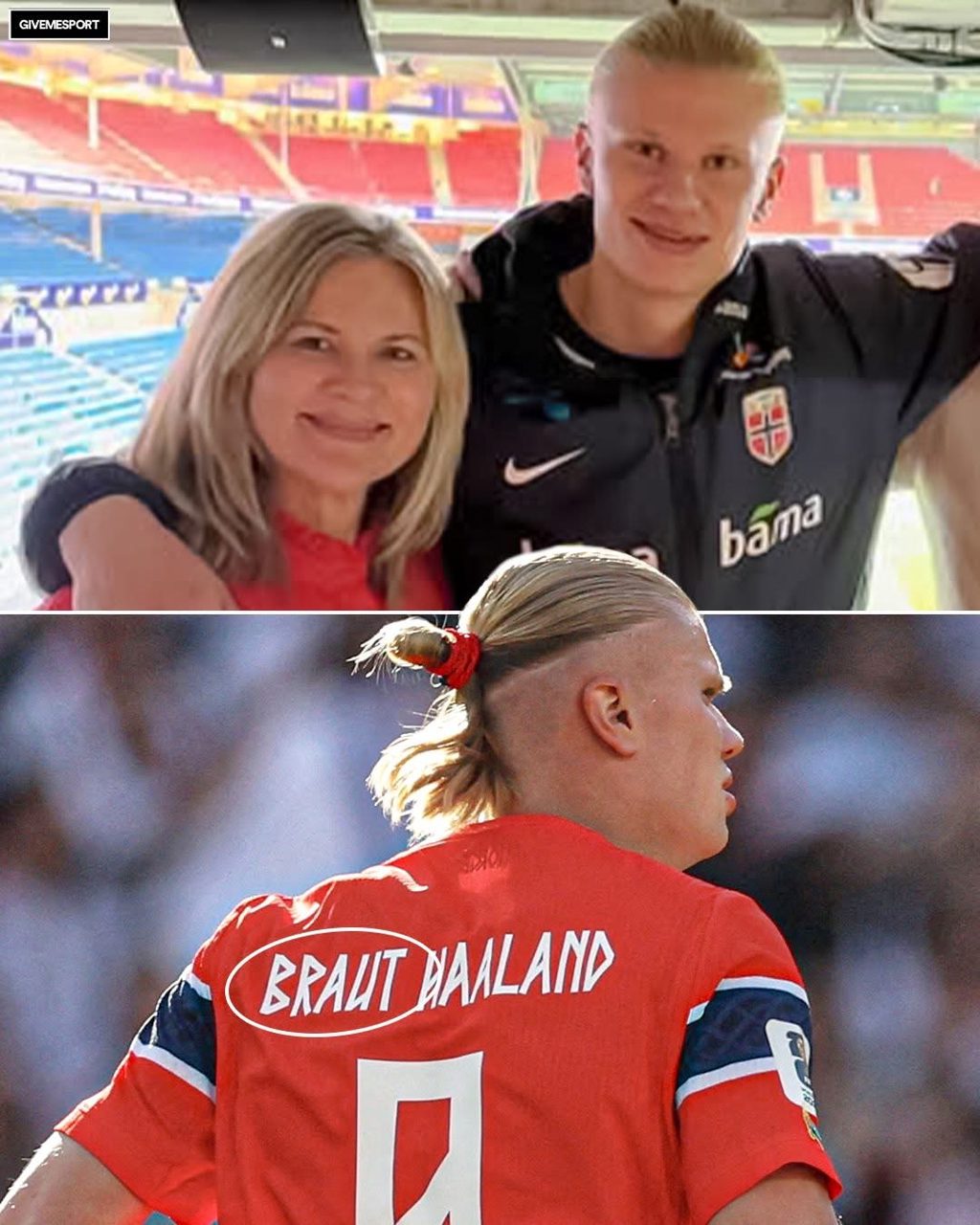
For most football fans, Erling Haaland is synonymous with goals, power, and that unmistakable blonde mane. But when the Norwegian striker pulls on his national team jersey, there is a detail that sets him apart from every other player on the pitch: the name on his back reads “BRAUT” – not “HAALAND.”
It is not a mistake, nor a quirky nickname. It is a deliberate, deeply personal tribute to the woman who shaped him as an athlete – his mother, Marita Braut.
Sources close to the Norwegian Football Federation (NFF) have confirmed that Haaland personally requested the change shortly after his senior debut, and the federation readily approved. Since then, for every international fixture – from World Cup qualifiers to Nations League matches – the Manchester City superstar has proudly worn his mother’s maiden name.
The decision, as Haaland has explained in rare interviews, stems from a powerful recognition of his parents’ distinct roles in his development. While his father, former Leeds United and Manchester City midfielder Alf-Inge Haaland, ignited his love for the beautiful game, it was Marita – a former professional heptathlete and multiple Norwegian national champion – who instilled the relentless discipline, physical conditioning, and mental toughness that have become his trademarks.
“Football came from my father, but the work ethic came from my mother,” Haaland once told Norwegian broadcaster NRK. “She taught me that you don’t win by talent alone – you win by preparing, by recovering, by pushing your body when it hurts. That is her legacy.”
Marita Braut was a force in Norwegian athletics during the 1990s, dominating the heptathlon – a gruelling seven-event competition that demands speed, power, agility, and endurance. Her championship pedigree is evident in Haaland’s explosive acceleration, his aerial dominance, and his almost robotic recovery between matches. In fact, fitness coaches have often noted that Haaland’s training regimens are more akin to a decathlete’s than a traditional footballer’s.
The “Braut” tribute is especially poignant given Haaland’s global superstardom. While he is universally known by his father’s surname at club level – where he has shattered Premier League and Champions League scoring records – he chooses to honour his mother on the international stage, where national identity matters most.
Interestingly, Haaland is not the first Norwegian athlete to adopt such a tribute. In Norwegian culture, the mother’s maiden name can be a proud marker of lineage, but Haaland’s choice is particularly rare in elite football, where a player’s surname is often viewed as a brand.
The gesture has not gone unnoticed by his mother. In a rare public comment earlier this year, Marita Braut told a local newspaper: “I was surprised when Erling told me, but also deeply moved. He has always been a thoughtful boy, even when he was scoring 50 goals a season for his youth teams. To see him carry my name on his chest – it’s a feeling I can’t put into words.”
Fans have embraced the detail, often chanting “Braut” during Norway home games, and the name has become a talking point among pundits. For many, it serves as a reminder that even the most extraordinary talents are shaped by the quiet, often unheralded sacrifices of their families.
As Haaland continues to chase World Cup glory with Norway – a nation that has yet to qualify for the tournament since 1998 – he does so with a name that bridges two generations. On his back is “Braut,” a tribute to his mother’s athletic ferocity. On his feet, he carries the technical genius of his father. And in his heart, he carries the determination of both.
For Erling Haaland, football is not just a career – it is a family legacy, written in two surnames, one of which he saves for his country. And that, perhaps, is the most beautiful assist of all.
订阅 AfroAsia Media 新闻简报
每日非洲与亚洲要闻,直接发送到您的邮箱。




评论
0 条评论
加载中…