
Nous traduisons cet article en français — la traduction s'affichera ici dans un instant. En attendant, voici la version originale en anglais.
’No one wants to be here’: Tuchel’s brutal honesty as England face unwanted third-place final
The press conference room at Wembley had the sombre atmosphere of a wake. Thirty-six hours after Lautaro Martínez’s 94th-minute dagger sent Argentina into the World Cup final, Thomas Tuchel sat before the assembled media, his face etched with exhaustion, his voice carrying the flat monotone of a man still processing the cruelest of defeats. England’s…
Publié le 6 min de lecture
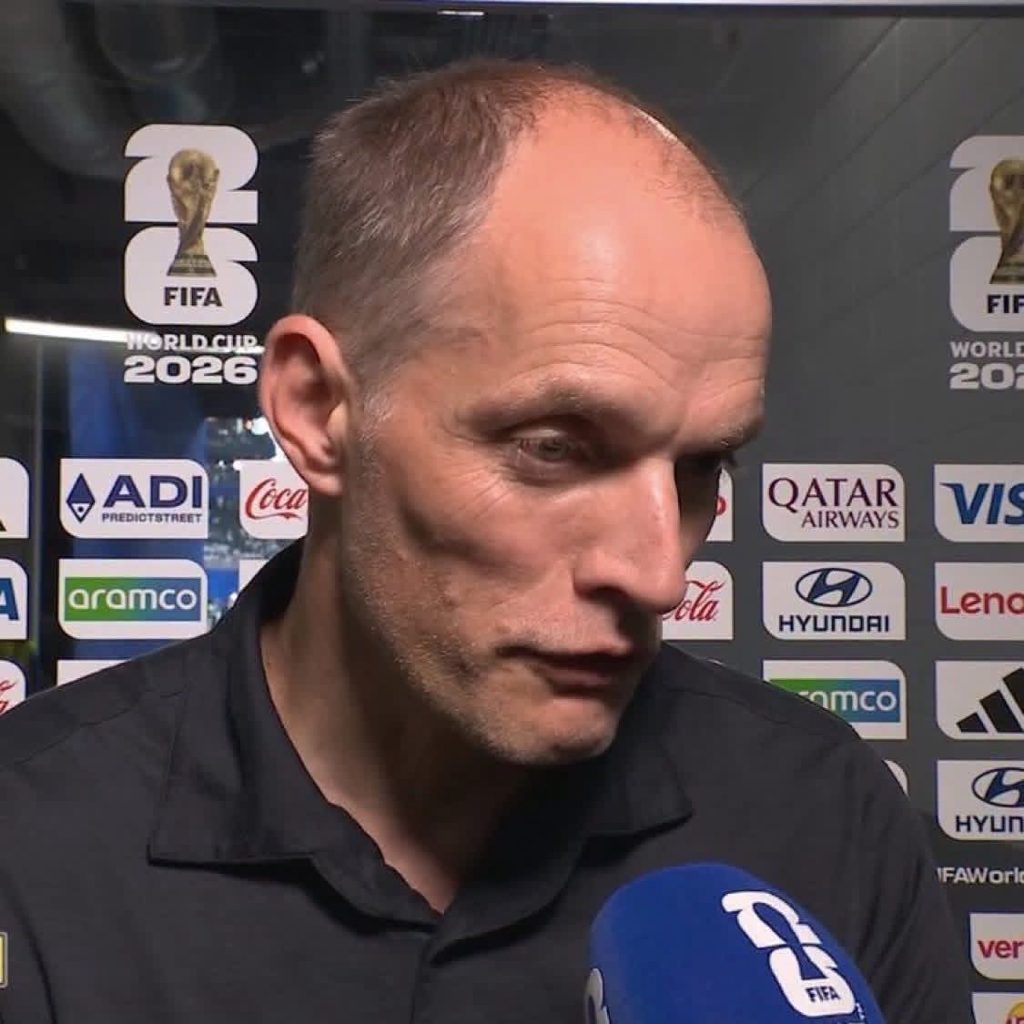
The press conference room at Wembley had the sombre atmosphere of a wake. Thirty-six hours after Lautaro Martínez’s 94th-minute dagger sent Argentina into the World Cup final, Thomas Tuchel sat before the assembled media, his face etched with exhaustion, his voice carrying the flat monotone of a man still processing the cruelest of defeats.
England’s manager did not mince words. He did not reach for platitudes or talk of pride in the journey. With a candour that bordered on brutal, Tuchel laid bare the emotional wreckage of a semi-final that had slipped through his team’s fingers – and the unwanted task that now awaits them: a third-place play-off against France on Saturday evening.
“None of our players, nor any of the French players, want to play the third-place match,” Tuchel admitted, his gaze fixed somewhere beyond the bank of cameras. “They want to play in the final. We gave everything to get there. Everyone plays to win the World Cup, but that’s how it is.”
The words hung in the air, a stark acknowledgment of football’s cruelest consolation prize. For a squad that had dreamed of lifting the golden trophy aloft on home soil, the prospect of a bronze-medal match feels less like an opportunity and more like a punishment – a televised reminder of what they came so agonisingly close to achieving.
Tuchel, however, was careful not to dismiss the fixture entirely. Despite the emotional toll, he insisted that professionalism would prevail. “We have one less day of recovery than France,” he noted, referencing the scheduling quirk that gives Didier Deschamps’ side an extra 24 hours to prepare after their own semi-final defeat to Brazil. “But we will approach it with professionalism.”
A draining week
The statistics paint a harrowing picture of England’s physical state. After a gruelling 120-minute quarter-final against the Netherlands and a semi-final that demanded relentless pressing for over an hour before Argentina’s tactical turnaround, Tuchel’s squad is running on fumes. Key players – Bukayo Saka, Declan Rice, and John Stones – have logged more minutes than any other outfield players at the tournament. The extra day’s recovery afforded to France, who lost their semi-final on Wednesday evening, could prove decisive in a match where motivation is already dangerously low.
Yet Tuchel refused to use fatigue as an excuse. “We are not going to stand here and complain,” he said. “France have earned their extra day by playing earlier in the week. That is the schedule. My job is to find a team that is physically and mentally ready to compete. Whether they want to be there or not, they will wear the shirt with honour.”
The third-place play-off has long been football’s most awkward fixture – a game that exists more for commercial obligations and FIFA’s schedule than for competitive integrity. Since 1978, when Brazil defeated Italy 2-1 in Buenos Aires, the match has often been treated as a glorified friendly, with managers rotating squads and players struggling to summon the intensity that defined their previous outings.
Tuchel, however, hinted that he may use the fixture to blood younger players and offer consolation minutes to those who have featured sparingly. “There are players in this squad who have given everything in training, who have supported their teammates from the bench, and who deserve to feel the grass of Wembley in a World Cup match,” he said. “That is one way to find meaning in this.”
The shadow of the semi-final
Inevitably, the questions returned to Argentina. Tuchel was pressed on Jamie Carragher’s withering critique that his substitutions had cost England the game. The German’s jaw tightened, but he remained measured.
“Everyone is entitled to their opinion after the fact,” he replied. “I made the decisions I believed would protect our lead and see us through. In hindsight, they did not work. That is the burden of this job. I accept it. But I will not apologise for trying to win a football match. If I had done nothing and we had conceded, they would say I was passive. I made changes, and they say I was reckless. That is the nature of defeat.”
He refused to single out Jordan Pickford for the equaliser, or blame his defensive reshuffle for the breakdown in set-piece organisation. “We win together, we lose together. That has been the mantra of this group from day one. I will not break that now.”
A fractured dream
For England’s supporters, the third-place play-off represents a hollow denouement to a tournament that promised so much. The nation had dared to believe – not just because of Tuchel’s reputation, but because of the fluency and control they displayed for 72 minutes against Argentina. That brief period of dominance now feels like a cruel mirage, a glimpse of a future that evaporated in the chaos of a single corner routine and a goalkeeper’s uncharacteristic error.
Tuchel, who was appointed precisely to navigate these high-stakes moments, now finds himself in the unfamiliar position of managing a team that has to pick itself up from the canvas with barely 48 hours to prepare. The French, themselves wounded by a 2-1 loss to Brazil, will be equally disenchanted, but they possess a deeper squad and the psychological advantage of a cleaner bill of health.
“Third place is still a medal,” Tuchel said, almost as if trying to convince himself. “It is not the one we came for, but it is a recognition of reaching the final four of the world. There are 32 teams who started this tournament. Only four remain. That is not nothing.”
The bigger picture
Behind the scenes, the FA will already be conducting their internal review. Tuchel’s contract runs through to the next European Championship, and there is no suggestion of any immediate upheaval. But the questions that Carragher raised – about the FA’s belief in a “world-class manager” being immune to error – will linger like a persistent fog.
For now, however, Tuchel’s focus is solely on Saturday. He confirmed that captain Harry Kane, who has played every minute of the tournament despite a niggling ankle issue, will be given a late fitness test. “Harry wants to play,” Tuchel said. “He always wants to play. But I have to protect him from himself. We will decide in the morning.”
As the press conference concluded, Tuchel stood up, adjusted his jacket, and offered one final, weary reflection. “When you lose a semi-final, the last thing you want is another match. But we are professionals. We represent England. And for the fans who have travelled from every corner of this country to support us, we owe them 90 minutes of honest football. Whether it feels like a final or not, we will treat it as one.”
It was a brave face on a broken dream. But in the cavernous corridors of Wembley, with the faint echoes of Argentina’s celebrations still lingering, the truth was unmistakable: England’s World Cup ended on Tuesday night. Saturday is merely the epilogue.
Recevez la newsletter d'AfroAsia Media
Les principales actualités du jour en Afrique et en Asie, directement dans votre boîte mail.




Commentaires
0 commentaire
Chargement…