
Nous traduisons cet article en français — la traduction s'affichera ici dans un instant. En attendant, voici la version originale en anglais.
Mahama urges Africa-Caribbean to transform shared history into shared prosperity
President John Dramani Mahama has called for a strengthened partnership between Africa and the Caribbean, urging the two regions to move beyond sentimental ties and build a pragmatic economic alliance rooted in trade, investment, innovation and coordinated global advocacy. Delivering an address to a special joint sitting of the Jamaican Parliament in Kingston on Tuesday,…
Publié le 4 min de lecture
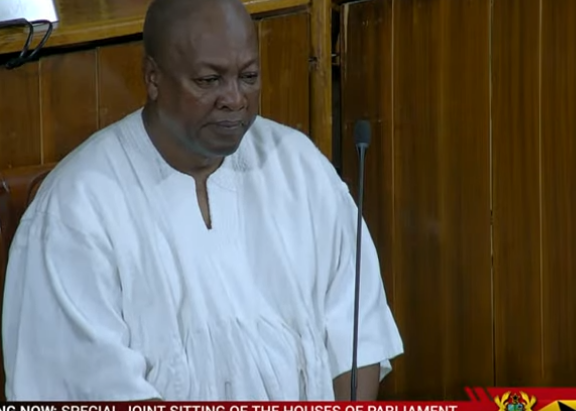
President John Dramani Mahama has called for a strengthened partnership between Africa and the Caribbean, urging the two regions to move beyond sentimental ties and build a pragmatic economic alliance rooted in trade, investment, innovation and coordinated global advocacy.
Delivering an address to a special joint sitting of the Jamaican Parliament in Kingston on Tuesday, August 4, during his state visit to the Caribbean island nation, President Mahama said the historic bonds forged through the transatlantic slave trade and shared struggles for liberation must now serve as a springboard for tangible development.
“The challenge before us has never been clearer,” he told the assembled lawmakers. “We must transform our shared history into shared prosperity. We must move beyond sentiment and build partnerships that create opportunities, expand prosperity and improve the lives of our people.”
A vision rooted in Nkrumah’s legacy
The President invoked the words of Ghana’s first President, Dr. Kwame Nkrumah, whose pan-Africanist vision laid the intellectual foundation for African-Caribbean solidarity during the independence era.
“As our first President, Dr. Kwame Nkrumah, reminded us, ‘The forces that unite us are intrinsic and greater than the superimposed influences that keep us apart,'” Mahama quoted. “Those words speak as powerfully to us today as they did at the dawn of African liberation.”
He stressed that the current generation must focus on achieving economic transformation, scientific advancement and technological progress, while also ensuring the liberation of the African mind from colonial mentalities.
“It demands confidence in our own institutions. It demands belief in our own capabilities and an unwavering commitment to accountability and excellence,” he said. “Above all, it requires that our young people see themselves not as descendants of slaves, but as heirs to greatness and architects of an even greater future.”
Complementary strengths
President Mahama highlighted the complementary strengths of both regions, noting that Africa’s youthful population, abundant natural resources and growing innovation ecosystem position the continent for rapid development. Jamaica, he said, continues to provide global leadership on climate justice, sustainable development, democracy and multilateral cooperation.
He described Jamaica as an important gateway to the Americas and said both regions possess enormous human talent, cultural influence and economic potential that remain underexploited.
“History has connected us, and the future now calls upon us to work together,” he said.
Institutional collaboration
The President called for deeper cooperation between the African Union and the Caribbean Community (CARICOM), as well as closer coordination within the United Nations and other multilateral forums.
“We must coordinate our positions on issues that will define the future of humanity,” he said. “Whether the challenge is climate change, reform of the international financial architecture, food security, public health or digital transformation, our voices will carry greater weight if we speak together.”
He argued that the Africa-Caribbean partnership should no longer be defined solely by a shared past but by a shared vision for the future—one that leverages collective bargaining power on the global stage.
The Accra Reforms initiative
President Mahama also used the occasion to promote Ghana’s recently launched Accra Reforms initiative, which he described as a blueprint for reshaping global governance and creating a more equitable international system.
“The Accra Reforms reflect our belief that the institutions governing the world must evolve to reflect the realities and aspirations of the 21st century,” he explained.
He noted that too many developing countries continue to face structural barriers, including limited access to financing, unfair trading arrangements and inadequate representation in global decision-making bodies.
“These inequities cannot define our future,” he said. “The Accra Reforms call for a new development paradigm founded on mutual respect, productive investment and genuine partnership.”
UN Security Council reform
President Mahama reiterated Ghana’s long-standing call for comprehensive reform of the United Nations, including permanent African representation on the UN Security Council. He argued that developing countries must participate as equal partners in shaping global solutions, rather than being passive recipients of policies crafted elsewhere.
Diplomatic context
The state visit to Jamaica is part of President Mahama’s broader diplomatic offensive to strengthen Ghana’s ties with the Caribbean, a region with which Ghana shares deep cultural and historical connections. Jamaica is home to a significant population of Ghanaian descent, and the two countries have maintained cordial relations since Ghana’s independence in 1957.
The visit is expected to yield bilateral agreements in the areas of trade, tourism, education and cultural exchange, with both sides expressing optimism about the potential for expanded cooperation.
Significance and outlook
Analysts view President Mahama’s address as a significant reaffirmation of Ghana’s pan-African credentials and its role as a bridge between Africa and its diaspora. The call for coordinated action on global issues also aligns with Ghana’s foreign policy objectives of amplifying the voice of the Global South in international affairs.
As Africa and the Caribbean confront shared challenges—from climate vulnerability to debt distress—President Mahama’s vision of a partnership rooted in mutual interest rather than nostalgia may offer a path toward greater collective resilience and influence on the world stage.
Recevez la newsletter d'AfroAsia Media
Les principales actualités du jour en Afrique et en Asie, directement dans votre boîte mail.




Commentaires
0 commentaire
Chargement…