
Nous traduisons cet article en français — la traduction s'affichera ici dans un instant. En attendant, voici la version originale en anglais.
IMF mission arrives in Accra for first PCI review, with 2027 budget and energy debts in focus
An International Monetary Fund (IMF) mission is expected in Accra this week for Ghana’s first review under the Policy Coordination Instrument (PCI), with preparations for the 2027 Budget and the government’s lingering energy-sector liabilities set to dominate discussions, JoyBusiness has learned. The mission, led by Dr Ruben Atoyan, the IMF’s Division Chief for the African…
Publié le 5 min de lecture
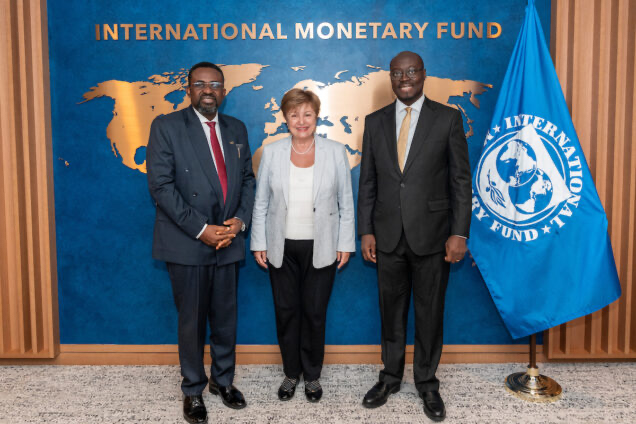
An International Monetary Fund (IMF) mission is expected in Accra this week for Ghana’s first review under the Policy Coordination Instrument (PCI), with preparations for the 2027 Budget and the government’s lingering energy-sector liabilities set to dominate discussions, JoyBusiness has learned.
The mission, led by Dr Ruben Atoyan, the IMF’s Division Chief for the African Department who steered Ghana’s just-concluded Extended Credit Facility (ECF) programme, is expected to last two weeks, according to sources contacted on the sidelines of the IMF/World Bank Annual Meetings in Bangkok, Thailand. The team will assess Ghana’s economic performance and progress on reforms aimed at sustaining the macroeconomic stability achieved under the now-completed lending arrangement.
A New Framework Without Financing
The visit marks Ghana’s first formal engagement with the Fund since the IMF Executive Board completed the sixth and final review of the country’s US371 million and bringing total support under the 39-month programme to nearly US$3 billion . At the same time, the Board considered Ghana’s request for a 36-month PCI, a non-financing instrument that allows countries to maintain close policy engagement with the IMF without receiving loan resources .
The PCI is structured around six pillars: sustaining growth-friendly fiscal adjustment; safeguarding debt sustainability; strengthening fiscal transparency and governance, particularly for state-owned enterprises; enhancing the monetary and exchange-rate policy framework; reinforcing financial sector stability; and supporting economic diversification and inclusive growth . Although it provides no direct funding, policies under the PCI must meet standards comparable to those under IMF lending arrangements, and performance is assessed through reviews on a fixed schedule, normally every six months.
Finance Minister Dr Cassiel Ato Forson has described the framework as the anchor for Ghana’s next phase of reforms, intended to preserve the gains made under the ECF while reinforcing policy credibility and investor confidence . Bank of Ghana Governor Dr Johnson Pandit Asiama has said the PCI will be integrated into the country’s monetary policy framework, reinforcing inflation targeting and strengthening the central bank’s balance sheet over the medium term following recent losses .
Why the 2027 Budget Matters
The 2027 Budget is expected to be a central item on the mission’s agenda. The government has signalled that the budget will unveil what Finance Minister Forson has called a “new economy” blueprint, a strategy for moving Ghana from economic stabilisation to a more productive and industrialised footing. At its centre is a proposed US$10 billion investment in strategic sectors over the next four years, aimed at boosting domestic production, promoting value addition, expanding exports and creating jobs .
The IMF will be watching closely to ensure that the budget’s spending plans remain consistent with the PCI’s fiscal anchors, including the government’s commitment to reduce public debt to 45 percent of GDP by 2034. The Fund has estimated that from 2027, a primary budget surplus equivalent to 0.5 percent of GDP would be consistent with debt sustainability, provided Ghana continues reforms to raise domestic revenue and improve public financial management . Revenue mobilisation is therefore likely to feature prominently, with the mission expected to examine fiscal performance through September 2026 and assess measures to improve government receipts.
Energy Debts: A Persistent Fiscal Risk
The energy sector’s legacy debts are expected to loom large over the discussions. Ghana’s state-owned enterprises carry total liabilities equivalent to roughly 25 percent of GDP, with the sector’s troubles concentrated in a handful of high-leverage entities. The Electricity Company of Ghana (ECG) alone owes GH¢71 billion, equivalent to about 6 percent of GDP, making it the single largest debt burden in the SOE portfolio and the government’s principal source of fiscal risk . The Volta River Authority and the Ghana National Petroleum Corporation also carry substantial debt stocks, much of it denominated in foreign currency or benefiting from implicit government guarantees .
The government has made significant strides in clearing arrears. In 2025, the Ministry of Finance paid approximately US597 million to restore the depleted World Bank Partial Risk Guarantee for the Sankofa gas project, some US393 million in legacy debts owed to Independent Power Producers . Yet independent verification by Joy Online found that after deducting the US707 million in restructured IPP debt remained outstanding as of January 2026, with the government having disclosed to the IMF a plan to reschedule the remaining payments over four to five years, potentially completing the process by 2028 .
The fiscal burden is not receding quickly. The Public Utilities Regulatory Commission has said the one-cedi fuel levy has raised about US92 million per month in fuel-cost subsidies to guarantee continued nationwide power supply . The IMF has repeatedly urged Ghana to strengthen oversight of state-owned enterprises in the energy sector, warning that their debts are deeply intertwined with the sovereign’s balance sheet and constitute a key transmission channel for fiscal and external vulnerability .
Banking Sector and Structural Reforms
Beyond the budget and energy, the mission is expected to examine the Bank of Ghana’s recapitalisation and the regulation of the wider financial sector. The IMF has recommended that the central bank complete a recapitalisation plan by 2032, permanently end quasi-fiscal operations and transfer the Domestic Gold Purchase Programme to GoldBod . Banking-sector supervision remains a concern, with non-performing loans still elevated among state-owned and some private institutions despite progress since the 2022 crisis .
The mission will also engage government officials, the central bank and other stakeholders before issuing a statement on its findings. The review comes at a delicate moment: Ghana has exited its bailout with broadly satisfactory marks—inflation at 5.3 percent in June 2026, international reserves nearly doubled to US$11.9 billion, and the primary fiscal balance in surplus—but the Fund has cautioned that maintaining discipline will be essential as external risks, including gold-price volatility, persist .
As the IMF team settles into Accra for two weeks of technical discussions, the first PCI review will test whether Ghana can translate the stability it achieved under the ECF into a credible, financing-free reform path—one that keeps the 2027 Budget within fiscal bounds, brings the energy sector’s liabilities under control, and convinces investors that the hard-won gains will hold.
Recevez la newsletter d'AfroAsia Media
Les principales actualités du jour en Afrique et en Asie, directement dans votre boîte mail.




Commentaires
0 commentaire
Chargement…