
Nous traduisons cet article en français — la traduction s'affichera ici dans un instant. En attendant, voici la version originale en anglais.
How can we be this wicked to ourselves? Wealthy developers block Accra’s waterways – and the poor pay the price
Every rainy season, the nation’s capital performs the same grim ritual. The skies open, the streets fill, the cameras roll, and officials arrive at flooded communities to promise action. Then the waters recede, the cameras leave, and nothing structurally changes. But as Accra drowns yet again, an urgent question echoes through devastated neighbourhoods: How can…
Publié le 5 min de lecture
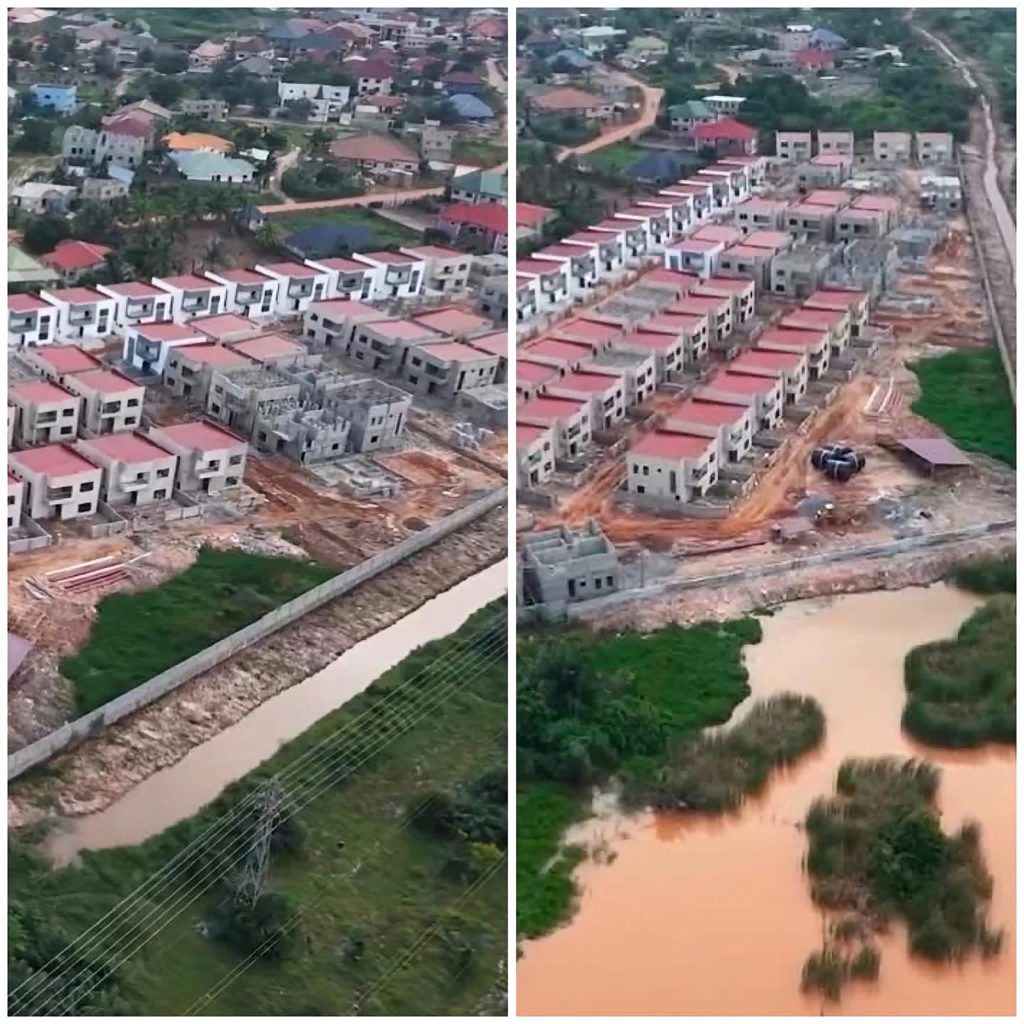
Every rainy season, the nation’s capital performs the same grim ritual. The skies open, the streets fill, the cameras roll, and officials arrive at flooded communities to promise action. Then the waters recede, the cameras leave, and nothing structurally changes.
But as Accra drowns yet again, an urgent question echoes through devastated neighbourhoods: How can we be this wicked to ourselves?
The answer lies not only in the skies above but in the concrete below – where wealthy developers and politically connected individuals have systematically blocked, filled, and built over the natural waterways that once carried stormwater safely to the sea.
A City That Drowns by Design
In early June 2026, Accra flooded again. Kwame Nkrumah Circle, Odawna, Adabraka, and the roads leading to the Tema motorway were underwater within hours. Days of heavy rain submerged large parts of the capital – from Kaneshie to Shiashie, from East Legon Hills to Oyarifa – destroying businesses and forcing families from their homes.
This is not a natural disaster. It is a manufactured one. Research analysing flood incidence and rainfall data in Accra found no statistical correlation between increased rainfall intensity and the rise in flooding frequency. The primary driver is land use failure.
Wetlands and buffer zones that once absorbed stormwater – including the Densu Delta, Sakumo Lagoon, and Songor Lagoon – have been systematically encroached upon by residential and commercial development, much of it permitted through political interference in planning enforcement. Over 52 percent of households surveyed in flood-prone areas identified weak enforcement of land use regulations as the principal cause of flooding.
The Rich Build, The Poor Drown
In Oyarifa, a suburb of Accra, the Flood Mitigation Task Force recently discovered that a private developer had constructed apartments directly over a natural watercourse – blocking the free flow of water and causing it to overflow into nearby communities.
When residents complained to the Accra Metropolitan Assembly, officials came, looked, and did nothing. A resident told the task force that the developer used land guards to terrorise anyone who raised concerns. “Anytime we complain, the individual uses land guards to terrorise us,” the resident said. “He claims he owns the drain.”
At the Tesa Dam, adjacent to East Legon Boundary Road, an inspection team found that the dam’s size had been significantly reduced due to encroachment. Some individuals had constructed illegal retaining walls within the area, while nearby sections had been occupied by densely populated slum settlements. The affected structures have been marked for demolition.
In East Legon Hills, where homes list for as much as $400,000, flooding had been flagged as a risk a full year earlier. Yet buyers continued to pay premium prices for properties built on documented flood risk. The name “East Legon Hills” itself is a rebrand – the area was formerly Nanakrom, a quiet peri-urban settlement. The marketing worked; the drainage did not keep pace.
‘They Know Their Locations Are Illegal’
The Mayor of Accra, Michael Kpakpo Allotey, has admitted that the Accra Metropolitan Assembly will begin removing unauthorised structures within 50 metres of the Odaw River. “They know their locations are illegal,” he said, “and we have given them enough time to vacate those places so that water can pass freely when it rains.”
But enforcement has been selective. Municipal Assemblies routinely issue building permits to wealthy developers to construct massive commercial plazas, gated estates, and multi-storey complexes right in known floodplains and natural retention basins. When individuals build without permits and block vital drainage paths, enforcement agencies look the other way – for years.
The cost is staggering. The World Bank estimates close to $3.2 billion in economic assets across Greater Accra already sit at risk of flooding – a figure projected to quadruple by 2050 if no new mitigation measures are taken.
‘We Must Repair the Roof’
President John Dramani Mahama has directed a coordinated crackdown on drainage blockages and ordered the demolition of structures illegally built within waterways. “I have directed a task force, NADMO and others to do a presentation. We will identify all restricted waterways,” the President said. “I am giving the directive to go ahead and do what must be done.”
He has also directed the release of GH¢300 million from the Contingency Fund for post-flood relief and mitigation.
But the President himself has acknowledged that the blame is widely shared. Those who sell land in restricted areas, district assemblies that grant building permits in waterway zones, and residents who dump waste into drains all share in the problem.
A Call for Justice – and Accountability
Civil society leaders are demanding more. Franklin Cudjoe, President of IMANI Africa, has called for the removal of all illegal structures on wetlands and waterways “without favour or fear”. “How is this not indiscipline aided by weak enforcement of building codes and corruption?” he asked.
“We first need the Army, which has already been engaged by the government, alongside citizen vigilantes, relevant Civil Society voices, and relentless public education, to remove all illegal structures without favour or fear,” Cudjoe said. “They should reclaim the lands to their original state and send the bill to all who allowed the concrete structures to be built and those who built them.”
The Wickedness We Inflict on Ourselves
The question that haunts every flooded neighbourhood remains unanswered: How can we be this wicked to ourselves?
Natural wetlands and retention ponds are not empty, wasted spaces. They are thousands-of-years-old ecological infrastructure designed by nature to hold millions of gallons of excess water until it can safely recede. When they are systematically filled with sand and replaced with concrete, the water doesn’t simply disappear because someone has a land title. It finds the path of least resistance – which happens to be the living rooms of ordinary citizens.
For every square metre of waterway filled, hundreds of cubic metres of floodwater are displaced onto neighbouring streets, schools, and hospitals. The rich profit; the poor perish.
And when the floods come, the government takes the blame – rightly so. But what about the individuals and companies that physically destroyed our natural defences? Their names are on land titles. Their logos are on construction hoardings. Yet not a single waterway blocker has been prosecuted for environmental sabotage, despite the deaths that follow every rainy season.
“If you think you are bigger than the law, then go and build on the moon,” one community leader in flood-ravaged Oyarifa told this reporter. “Leave our waterways for water.”
The question is simple. The answer is not. But one thing is clear: this nonsense must stop.
Recevez la newsletter d'AfroAsia Media
Les principales actualités du jour en Afrique et en Asie, directement dans votre boîte mail.




Commentaires
0 commentaire
Chargement…