
Nous traduisons cet article en français — la traduction s'affichera ici dans un instant. En attendant, voici la version originale en anglais.
GhIE outlines 19-point strategy to end recurrent flooding in Ghana
The Ghana Institution of Engineering (GhIE) has unveiled a comprehensive 19-point plan aimed at ending the country’s perennial flood disasters, warning that the persistent loss of life is caused by a failure to execute well-known engineering solutions rather than a lack of technical knowledge. The position statement, released on June 30 in the aftermath of…
Publié le 3 min de lecture
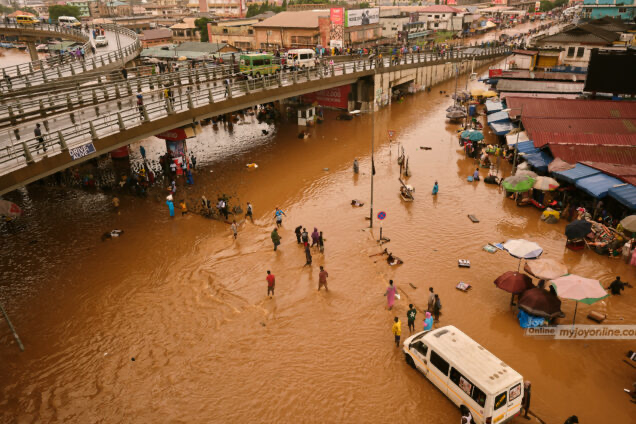
The Ghana Institution of Engineering (GhIE) has unveiled a comprehensive 19-point plan aimed at ending the country’s perennial flood disasters, warning that the persistent loss of life is caused by a failure to execute well-known engineering solutions rather than a lack of technical knowledge.
The position statement, released on June 30 in the aftermath of last week’s torrential rains which claimed at least 12 lives and displaced thousands in the capital, called for a sweeping shift from ad-hoc emergency responses to long-term, integrated urban planning.
At the top of the institution’s agenda is the immediate rehabilitation of the Odaw River and Korle Lagoon drainage system, which GhIE described as a “national priority.” The engineers are urging authorities to commission an independent review of the current restoration works on the lagoon to identify specific engineering bottlenecks before undertaking urgent repairs.
The GhIE also zeroed in on sanitation failures, demanding the restoration of dependable waste collection services across all communities alongside strict enforcement of sanitation by-laws. “Get established collection back on a dependable schedule in every community, so that households are not forced to choose between costly informal collectors and the nearest gutter,” the statement read, emphasizing that waste management must be treated as a permanent “essential service” rather than a seasonal campaign.
Infrastructure design came under heavy scrutiny as well. The engineers urged the formal integration of the Department of Urban Roads and the Ghana Highway Authority into the national flood response strategy. They demanded that all new road projects incorporate functional drainage systems backed by dedicated maintenance budgets. “A road built without a working drain is just a future flood channel,” the institution warned.
Tackling unregulated development, GhIE advocated for a National Post-Development Runoff Control Policy and called for the strict enforcement of planning regulations. This includes halting construction on wetlands and waterways, removing illegal structures from major drains, and banning full-plot paving. “Stop building in the wrong places, and mean it,” the engineers urged, acknowledging that confronting powerful interests is difficult but essential.
To complement traditional concrete drains, the statement promoted nature-based solutions, such as creating detention ponds and piloting rain gardens and bioswales in rapidly urbanizing areas including Adenta, Kasoa, and Weija. For long-term resilience, the body called for a mandatory National Rainwater Harvesting Policy and a fundamental shift in drainage philosophy—moving away from rapidly channeling stormwater away to capturing and absorbing it close to where it falls.
Concluding the position statement, the GhIE stressed that Ghana’s recurring floods are not caused by rainfall alone but by systemic failures in planning and enforcement.
“Ghana does not have a knowledge problem. We have an action problem,” the statement declared, reflecting on previous tragedies including the 2015 June 3 disaster. “The plans are written. The warnings have been given. What we need now is the will to act, before the next rain falls.”
The institution reaffirmed its readiness to collaborate with the Ministry of Works and Housing and local assemblies to translate its proposals into practical solutions.
Recevez la newsletter d'AfroAsia Media
Les principales actualités du jour en Afrique et en Asie, directement dans votre boîte mail.




Commentaires
0 commentaire
Chargement…