
Nous traduisons cet article en français — la traduction s'affichera ici dans un instant. En attendant, voici la version originale en anglais.
Ghana to build new landfills in Greater Accra, Eastern Region as Kpone reaches capacity- Ayariga
The government is planning to construct new landfill sites in the Greater Accra and Eastern Regions to ease mounting pressure on the country’s waste disposal infrastructure, Minister for Local Government, Chieftaincy and Religious Affairs Mahama Ayariga has announced. Speaking on Eyewitness News on Monday, September 29, 2026, Ayariga said the Kpone landfill has reached capacity…
Publié le 5 min de lecture
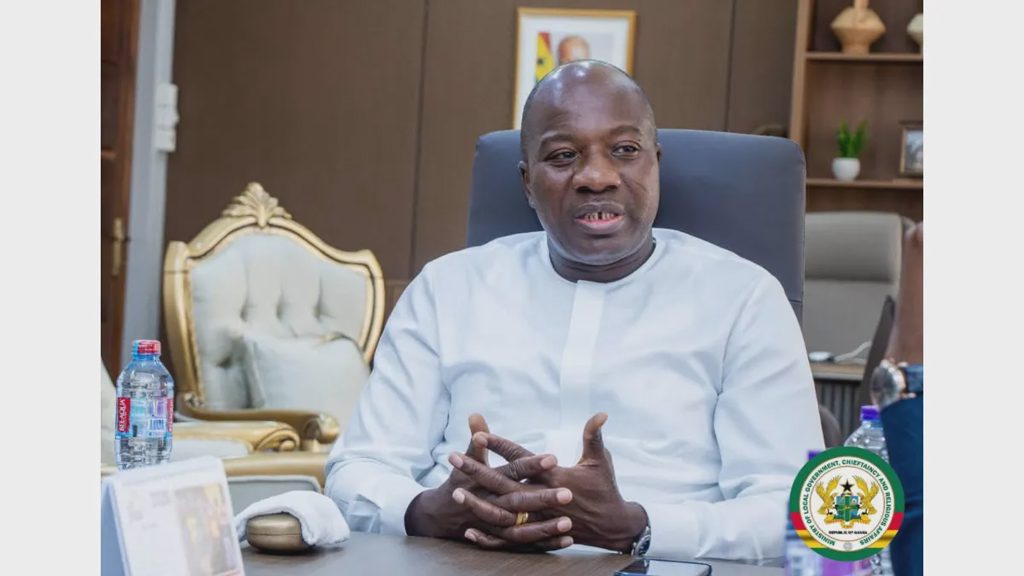
The government is planning to construct new landfill sites in the Greater Accra and Eastern Regions to ease mounting pressure on the country’s waste disposal infrastructure, Minister for Local Government, Chieftaincy and Religious Affairs Mahama Ayariga has announced.
Speaking on Eyewitness News on Monday, September 29, 2026, Ayariga said the Kpone landfill has reached capacity and is being prepared for decommissioning.
“We have plans to construct new landfill sites across the Greater Accra area and Eastern Region to accommodate the waste that is being generated,” he said. “The Kpone landfill site, as you can see, is full. So we’re in the process of planning its decommissioning.”
The announcement comes amid a deepening sanitation crisis in Greater Accra, where daily waste generation is estimated at between 4,000 and 5,000 tonnes. The region currently relies on the exhausted Kpone facility and the Adepa landfill near Nsawam in the Eastern Region. The Adepa site can receive up to 4,000 tonnes per day, but its distance from Accra — more than 40 kilometres — makes it difficult for collection trucks to complete more than one trip daily, slowing refuse collection and contributing to illegal dumping.
Kpone, commissioned in 1996 with an expected lifespan of 33 years, was originally intended to serve only the Tema Municipality. After the closure of the Insumia landfill, it became the primary disposal point for seven assemblies, drastically shortening its operational life. The facility was capped in 2019, but an older section was later reopened as an emergency measure.
Ayariga said the shortage of engineered landfill facilities in some parts of the country was among the reasons behind the decision to transport waste from Agbogbloshie to another landfill site. In September 2026, President John Dramani Mahama ordered the evacuation of about one million tonnes of waste from Agbogbloshie, along the Odaw River, to the Adepa Engineered Landfill near Nsawam. The 90-day exercise, led by the Ministry of Local Government with support from the Ghana Armed Forces and the District Road Improvement Project, is intended to end decades of open dumping and burning at Agbogbloshie and clear the way for the proposed Agbogbloshie Urban Land Renewal Project, which includes plans for an industrial park and a textile factory.
However, the waste transfers have sparked tensions in the Eastern Region. Residents of the Adipa/Asiaw Electoral Area issued a seven-day ultimatum threatening to block roads leading to the landfill, citing offensive odours, fears of groundwater contamination and a lack of consultation. Assembly Member Emmanuel Asamoah said: “We are not against a fair, well-regulated waste management system, but we are against being treated as an afterthought, a convenient dumping ground for problems the capital does not want to face at all.” Ayariga later apologised to residents and assured them the landfill would be engineered and eventually decommissioned.
Three new regional landfills planned
The government’s broader plan involves establishing three new regional landfill sites in Greater Accra under a 50-year waste management development project. Samuel T.K. Morton, Municipal Chief Executive for Kpone Katamanso, has said land has been secured at Ayikuma, Sege and Paanor. Under the proposal, Greater Accra would be divided into three waste management zones, with each landfill receiving waste from designated districts and municipalities. A technical committee is finalising engineering designs for Cabinet approval.
Once operational, the Ayikuma landfill is expected to receive waste from tricycle operators who currently dispose of refuse at Kpone. Morton has also indicated that the Kpone site will be repurposed for waste-to-energy generation after decommissioning.
Moving beyond landfills
Beyond expanding landfill capacity, Ayariga said the government is considering alternative waste-management technologies, including incineration and waste-to-energy systems.
“I agree with him that there are new ideas about how to manage waste such as incineration and the conversion of waste to energy through burning it and then using the heat to generate energy,” he said.
He said stakeholders were already being engaged on how such technologies could be adopted as part of Ghana’s long-term waste-management strategy. “I have had those; even this morning I was in a meeting discussing how we should do that as a country,” he added.
The government’s broader approach, he said, would seek to move away from relying solely on landfill disposal by converting waste into useful resources, including energy. Proposals for two municipal solid waste-to-energy plants are already under discussion: one in the Kpone/Tema industrial corridor, processing 1,500 tonnes per day to generate about 40 megawatts of power, and another in the Dompoase/Atimatim corridor near Kumasi, processing 1,200 tonnes daily.
Polluter-pays principle
Ayariga has described the waste crisis as a national emergency requiring systemic reform. During a tour of waste management sites in Greater Accra on September 1, 2026, he outlined a three-pronged strategy: overhauling waste collection systems, decentralising infrastructure such as transfer stations and composting facilities, and investing in modern processing technology.
He also introduced the “Polluter Pays” principle as a cornerstone of the new waste management regime, stressing that the burden of sanitation cannot fall solely on government. “If we organize it well, we could reduce the cost per household of waste management by even 50 percent,” Ayariga said.
Dr. Peter Kwei Dagadu, Managing Director of Waste Landfills Company Ltd, has warned that Greater Accra faces an “acute disposal crisis,” noting that although the city previously operated about six waste transfer stations, only two are currently functional due to inadequate funding. He has called for the development of regional waste management infrastructure.
The government’s plans signal a shift in approach, but implementation will depend on funding, Cabinet approval, community acceptance and technical capacity. For now, Kpone’s closure looms, and the search for sustainable waste solutions has become increasingly urgent.
Recevez la newsletter d'AfroAsia Media
Les principales actualités du jour en Afrique et en Asie, directement dans votre boîte mail.




Commentaires
0 commentaire
Chargement…