
Nous traduisons cet article en français — la traduction s'affichera ici dans un instant. En attendant, voici la version originale en anglais.
From Ghana’s slums to Berlin’s glory: The extraordinary journey behind Nico Williams’ euros medal
When Nico Williams sprinted past England’s defense to score Spain’s opening goal in the Euro 2024 final on July 14, it was the culmination of a journey that began three decades earlier and thousands of miles away — not on a football pitch, but barefoot across the scorching sands of the Sahara Desert. After Spain’s…
Publié le 3 min de lecture
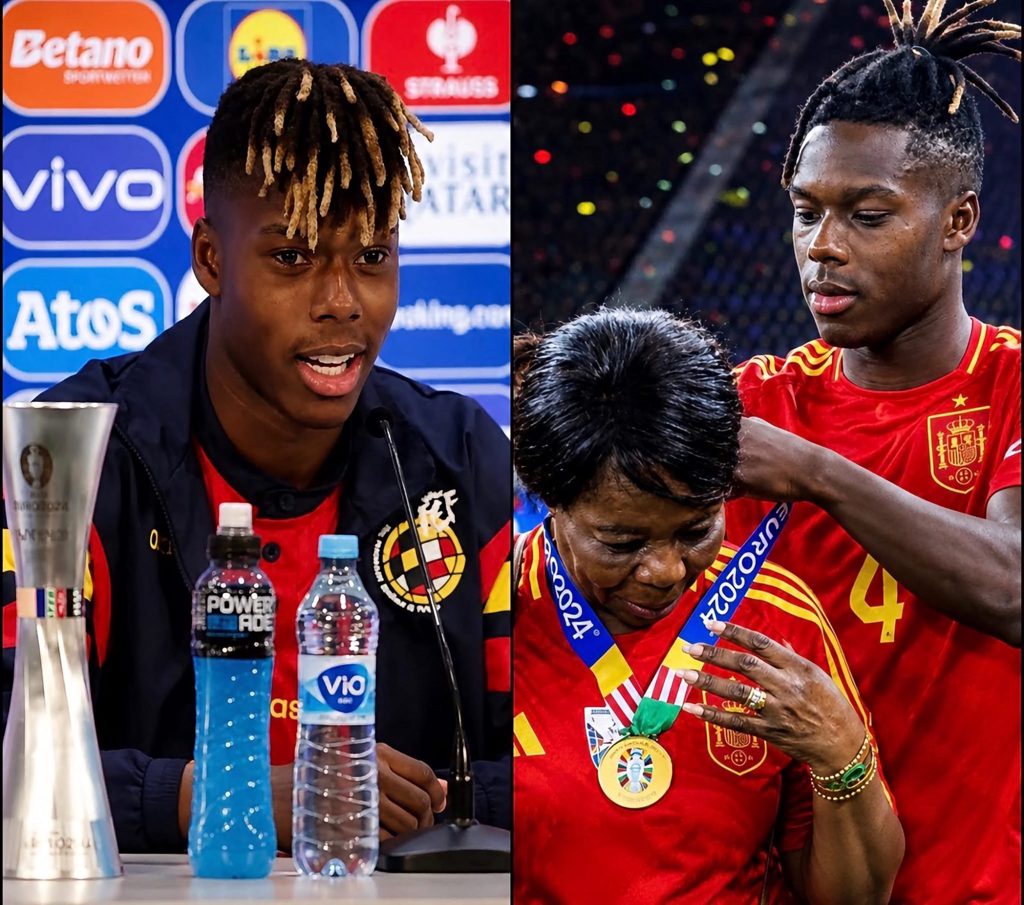
When Nico Williams sprinted past England’s defense to score Spain’s opening goal in the Euro 2024 final on July 14, it was the culmination of a journey that began three decades earlier and thousands of miles away — not on a football pitch, but barefoot across the scorching sands of the Sahara Desert.
After Spain’s 2-1 victory in Berlin, the 22-year-old Athletic Bilbao winger was named man of the match. But in a gesture that moved millions, Williams immediately ran to the stands, placed his winner’s medal around his mother Maria’s neck, and embraced her as she broke down in tears.
“I run fast, but not as fast as my mother,” Williams later explained. “She escaped death and crossed the Sahara from Ghana to Spain. I gave her my medal because she deserves it more.”
A Perilous Crossing
In 1994, Maria Arthuer and her husband Felix Williams left their home in Accra, Ghana’s capital, desperate for a better future. They entrusted their life savings to human traffickers who promised to take them to the United Kingdom. Instead, the gang abandoned them midway — stranded in one of the world’s most unforgiving environments.
What followed was a test of human endurance. The couple joined others in a trek across the Sahara, walking barefoot through sand that reached 40 to 50 degrees Celsius. Maria was already pregnant with her first son, Iñaki. Felix gave his shoes to his wife and walked barefoot himself — his feet became so badly burned that he suffered permanent damage.
They traversed approximately 5,000 kilometers, passing through Burkina Faso, Mali, Algeria, and Morocco before reaching Melilla, a Spanish enclave on North Africa’s Mediterranean coast. Along the way, they were robbed, and many of their fellow travelers perished.
A Twist of Fate
Upon arrival in Melilla, the couple was immediately detained by Spain’s Civil Guard and faced deportation. But a lawyer from the Catholic charity Caritas intervened with a bold suggestion: destroy their Ghanaian documents and claim they were from war-torn Liberia. Maria, who held Liberian papers, followed the advice. The strategy worked — they were granted political asylum.
A Catholic priest named Iñaki Mardones welcomed them and helped them rebuild their lives. The couple was so grateful that when their first son was born, they named him Iñaki in the priest’s honor. Eight years later, in 2002, Nico was born in Pamplona, Spain.
Building a New Life
The family settled in Pamplona’s poorer quarters. Felix traveled to England for work, taking jobs as a laborer, cleaner, and shepherd — even working on the turnstiles at Chelsea’s Stamford Bridge. He remained abroad for seven years. Meanwhile, Maria worked two or three jobs daily to support her children.
Growing up, Nico was raised largely by his mother and older brother Iñaki, who became a father figure in Felix’s absence. Both brothers eventually joined Athletic Bilbao’s academy — Iñaki first, then Nico. Today, they are teammates at the club, though they represent different nations: Iñaki plays for Ghana, while Nico chose Spain.
“She Is the Real Winner”
The Williams brothers only learned the full extent of their parents’ sacrifice when Iñaki was 18. “The story of your parents makes you fight even harder to give back everything they sacrificed for us,” Iñaki has said.
Nico echoed that sentiment after the Euro 2024 final. “My parents have suffered a lot to get here,” he told reporters. “They have instilled respect and loyalty in me.” “They risked their lives so that we, my brother and I, could have a better future. And they achieved that.”
As for the gold medal now hanging around his mother’s neck, Williams had no doubt about its rightful owner. “I gave the medal to my mother because she is the real winner,” he said.
Spain’s victory over England on July 14, 2024, marked the nation’s fourth European Championship title. Williams was also named to UEFA’s Team of the Tournament.
Recevez la newsletter d'AfroAsia Media
Les principales actualités du jour en Afrique et en Asie, directement dans votre boîte mail.




Commentaires
0 commentaire
Chargement…