
Nous traduisons cet article en français — la traduction s'affichera ici dans un instant. En attendant, voici la version originale en anglais.
FIFA refereeing chief Collins hits back at Egypt’s unfounded bias claims after controversial Argentina defeat
Pierluigi Collina, FIFA’s chief refereeing officer, has issued a fierce defence of World Cup match officials following explosive allegations from Egypt that their round-of-16 defeat to Argentina was “directed” in favour of the defending champions. In an interview published on FIFA’s website on Thursday, the legendary former Italian referee dismissed accusations of bias and insisted…
Publié le 4 min de lecture
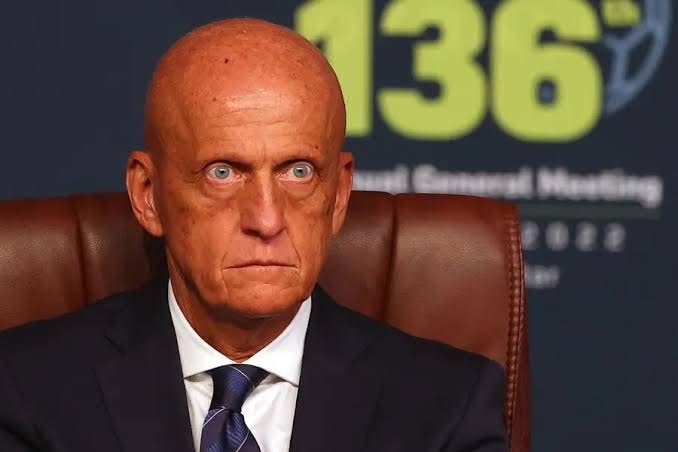
Pierluigi Collina, FIFA’s chief refereeing officer, has issued a fierce defence of World Cup match officials following explosive allegations from Egypt that their round-of-16 defeat to Argentina was “directed” in favour of the defending champions.
In an interview published on FIFA’s website on Thursday, the legendary former Italian referee dismissed accusations of bias and insisted that no external force—”not even by the FIFA president”—could influence officiating at the tournament.
The controversy erupted after Argentina staged a stunning comeback in Atlanta, overturning a 2-0 deficit to snatch a 3-2 victory with a stoppage-time winner from Enzo Fernandez. Egypt had led 1-0 in the second half when Mostafa Zico’s strike was overturned by VAR after midfielder Marwan Attia was penalised for stepping on Argentina defender Lisandro Martinez’s foot during the attacking possession phase. Egypt were also incensed that a challenge on Mohamed Salah in the Argentine penalty area was not penalised moments before the reigning champions broke for the winning goal.
Egypt coach Hossam Hassan did not hold back in his post-match criticism. “Perhaps they wanted to keep the world champion in the competition. Perhaps they wanted Messi to stay in the running,” he told reporters. The Egyptian Football Association (EFA) subsequently filed a formal complaint with FIFA, demanding an investigation into French referee Francois Letexier and calling for his removal from the tournament. The EFA said it “cannot remain silent” over what it described as “several key incidents” that “raised serious concerns and left profound questions about the consistency and fairness of decisions”.
Collina, who has chaired FIFA’s Referees Committee since 2017, acknowledged that refereeing decisions would always be debated but drew a firm line at questioning the integrity of match officials.
“Of course, constructive discussion about decisions will always be part of football, but unfounded allegations have no place in our sport,” Collina said. “Nobody can question the integrity of the FIFA World Cup match officials. When this happens, it may provoke reactions that lead to threats against them and their families. This is not right”.
The 66-year-old was adamant that FIFA’s refereeing operation operated with complete independence. “Equally, nobody can claim that FIFA refereeing can be influenced by anyone, not even by the FIFA president [Gianni Infantino],” he said. “He has always shown his full support for FIFA Team One while trusting us to work with complete independence. Match officials make honest decisions and, just like players and coaches, they always try to do their best”.
Despite not usually commenting on specific incidents during a major tournament, Collina backed both contentious decisions. Explaining the disallowed goal, he said: “After every goal is scored, the VAR checks the attacking possession phase (APP). If a foul is identified in the build-up and is deemed to have had an impact on the goal, the VAR will recommend an on-field review”. “There is no defined limit regarding either the distance from goal or the amount of time between the incident and the goal”.
On the Attia incident, Collina was unequivocal. “We believe that a foul is a foul. Regardless of whether the foul appears ‘obvious’, if the referee did not see it on the field of play, the VAR can intervene”.
Regarding Egypt’s penalty appeal involving Salah and Julian Alvarez, Collina said both the referee and VAR judged the contact to be “normal football contact”. “Stepping on an opponent’s foot is a foul, whereas a defender who touches the ball first and then makes normal football contact has not committed a foul,” he explained.
While acknowledging that some decisions would always involve an element of subjectivity, Collina said FIFA was satisfied with how VAR principles had been applied throughout the tournament.
The row comes as Egypt’s World Cup campaign ends in bitter disappointment, with Hassan having confronted Letexier after the final whistle and reportedly declaring he would not watch another minute of the tournament. The EFA’s formal complaint, which demands Letexier and his officiating team be excluded from any remaining matches, now awaits FIFA’s response.
Recevez la newsletter d'AfroAsia Media
Les principales actualités du jour en Afrique et en Asie, directement dans votre boîte mail.




Commentaires
0 commentaire
Chargement…