
Nous traduisons cet article en français — la traduction s'affichera ici dans un instant. En attendant, voici la version originale en anglais.
Bui Power Authority posts US145.9m in 2025 state-owned power producer exceeds generation targets, doubles solar capacity, and advances renewable projects despite sector-wide leadership changes
The Bui Power Authority (BPA) has recorded a robust financial performance for the 2025 fiscal year, posting a net profit of US145.9 million, according to its 2025 Corporate Annual Report released at the Authority’s annual stakeholders’ meeting on Thursday. The figures represent a net profit margin of over 45%, underscoring the efficiency of Ghana’s second-largest…
Publié le 4 min de lecture
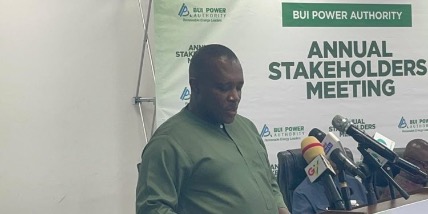
The Bui Power Authority (BPA) has recorded a robust financial performance for the 2025 fiscal year, posting a net profit of US145.9 million, according to its 2025 Corporate Annual Report released at the Authority’s annual stakeholders’ meeting on Thursday. The figures represent a net profit margin of over 45%, underscoring the efficiency of Ghana’s second-largest hydroelectric facility and its growing solar portfolio.
Speaking at the stakeholders’ gathering, BPA Chief Executive Officer Ing. Kow Eduakwa Sam described the results as a testament to the Authority’s resilience amid a turbulent year for the energy sector. “The 2025 financial year was characterised by leadership transitions at the Ministry of Energy, the Board of Directors and Executive Management of the Bui Power Authority. These changes were accompanied by broad shifts in policy direction across the sector. The Authority maintained operational stability and adapted to the new strategic direction,” he said.
The financial buoyancy was underpinned by a 6.7% increase in total electricity generation, which reached 1,438 gigawatt-hours (GWh) against a projected 1,350 GWh—surpassing the 2024 output of 1,348 GWh by a significant margin. Hydropower from the 404 MW Bui dam continued to dominate, contributing 1,339 GWh (a 5% year-on-year rise), while solar generation grew sharply to 102 GWh, up from 76 GWh in the previous year.
The surge in solar output was driven by the commissioning of 50 MWp from the ongoing 100 MWp solar photovoltaic project, bringing BPA’s operational land-based solar capacity to 100 MWp. Combined with its pioneering 5 MWp floating solar facility—the first of its kind in West Africa—total installed solar capacity now stands at 105 MWp, up from 55 MWp at the start of 2025. To stabilise the intermittent nature of solar, BPA also commissioned a 28 MWh Battery Energy Storage System (BESS), which enhances grid reliability and enables greater integration of renewables into the national transmission network.
The Authority also made headway on a persistent sector-wide challenge: outstanding receivables from key customers, particularly the Electricity Company of Ghana (ECG) and the Northern Electricity Distribution Company (NEDCo). Ing. Sam noted that although the problem remains, “the Authority saw improvement in some of its prevailing challenges, particularly the sector-wide receivables challenges with key customers, and will continue working to strengthen financial sustainability and deliver long-term value.” The report did not disclose the exact amount of receivables, but industry observers note that the improvement is critical, as legacy arrears have historically strained the cash flows of state-owned generators.
On the project front, BPA is pressing ahead with an ambitious pipeline. Work continues on the remaining 50 MWp phase of the 100 MWp solar project, the 50 MWp Yendi Solar PV Project, the 25 MWp floating solar expansion, and a renegotiated 20 MWp land-based solar project at the Bui Generating Station—all targeted for completion by the end of 2026. Looking further ahead, the Authority plans to commence feasibility studies for a massive 500 MWp solar PV plant paired with a 400 MWh BESS, while also breaking ground on a 200 MWp solar plant with a 100 MWh storage system, of which 80 MWp is expected to be online by late 2026. These additions are seen as vital to narrowing Ghana’s projected electricity supply-demand gap, which the Ministry of Energy has warned could widen as industrial demand grows.
Beyond generation, BPA is also exploring new hydropower opportunities. Feasibility studies for potential dams on the Tano, Pra, and Ankobra rivers, as well as Wli Falls, had reached 35% completion by year-end. If realised, these projects would diversify the country’s renewable base and improve system flexibility, complementing the existing hydro-solar mix.
Safety remained a hallmark of the Authority’s operations. Ing. Sam reported that BPA recorded zero lost-time injuries in 2025, maintaining a track record that has drawn praise from the Ministry of Energy. “The safety of our employees, contractors and host communities remained a top priority,” he said. “Throughout the year, the Authority maintained a strong safety culture aimed at preventing accidents and incidents.”
The 2025 performance comes at a time when Ghana’s energy sector is navigating a delicate balancing act between ageing thermal plants, rising fuel costs, and a push for cleaner sources. BPA’s shift toward solar and storage aligns with the government’s Renewable Energy Master Plan, which targets 10% renewable penetration by 2030—a goal that BPA’s current expansion could help accelerate.
Industry analysts have welcomed the results but caution that sustainability depends on timely payment settlements and the successful execution of the 2026 pipeline. “Bui Power has proven it can operate profitably and expand capacity simultaneously,” said energy economist Dr. Nana Adu of the University of Ghana. “But the receivables issue remains a structural risk. If ECG and NEDCo clear their arrears, BPA could invest even more aggressively in storage and transmission upgrades.”
BPA’s stakeholders’ meeting also drew representatives from the Ministry of Finance, the Public Utilities Regulatory Commission (PURC), and civil society groups, all of whom lauded the Authority’s transparency and operational discipline. With a healthy balance sheet and a clear roadmap, the Authority appears well-positioned to play an even larger role in Ghana’s energy transition—provided the political and financial winds remain favourable.
Recevez la newsletter d'AfroAsia Media
Les principales actualités du jour en Afrique et en Asie, directement dans votre boîte mail.




Commentaires
0 commentaire
Chargement…