
Wassa Fiase Chiefs Reject Gold Fields Lease Renewal, Demand Tarkwa Mine Be Handed to Ghanaian Operator
The Wassa Fiase Traditional Council has unanimously called on the government not to renew Gold Fields Ghana Limited's mining leases for the Tarkwa Gold Mine when they expire in April 2027, demanding…
Journalist
Published 5 min read
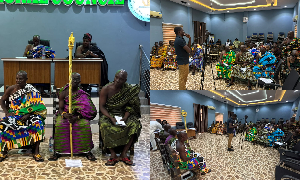
The Wassa Fiase Traditional Council has unanimously called on the government not to renew Gold Fields Ghana Limited's mining leases for the Tarkwa Gold Mine when they expire in April 2027, demanding instead that the concession be transferred to a capable Ghanaian investor to operate.
The chiefs, speaking at a general meeting of the Traditional Council on Wednesday, November 4, 2026, said decades of mining in the area have not brought sufficient development to host communities, citing poor roads and infrastructure, inadequate corporate social responsibility projects, and delays in the payment of royalties . They appealed to President John Dramani Mahama and the government to give a capable Ghanaian investor the opportunity to take over the mine, arguing that indigenous ownership would ensure more of the benefits flow to host communities and the national economy .
The demand has received backing from the Apinto Divisional Council, within whose jurisdiction the mine is located. The Council has petitioned the government against renewing Gold Fields' leases and is calling for the concession to be transferred to a Ghanaian investor .
Queen Mother: "A Ghanaian Deserves the Opportunity Now"
The Paramount Queen Mother of the Wassa Fiase Traditional Area, Nana Abena Konadwoa II, expressed disappointment with Gold Fields' contribution to community development, arguing that the benefits received by residents were inadequate compared with the years of mining activity. She referred to the company's profits in 2025 and the first half of 2026, comparing them with royalties paid and CSR projects undertaken, though specific figures were not provided at the meeting .
"When you compare the huge revenue generated from gold to what has been given back to the nation and the host community, it is clear that a Ghanaian deserves the opportunity now," she said . She explained that the Council's decision was not borne out of hatred, but out of a desire for development.
Nana Abena Konadwoa II also pointed to the poor state of roads and other infrastructure in Wassa Fiase, saying repeated appeals for support had not yielded the expected results. She contrasted the situation with development projects emerging in the Damang enclave following the transfer of the Damang Mine to Ghanaian ownership, citing improvements in roads, hospitals, an astroturf facility and an airport project as examples of what indigenous ownership could achieve .
Royalty Delays and Divisional Support
Nana Adu Panyin of the Apinto Divisional Council raised concerns about delays in the payment of royalties due to the traditional area. The Traditional Council's registrar told the meeting that the money had been deposited into an account but could only be released once an ongoing land dispute was resolved .
Other traditional leaders, including Nana Kwabena Gyan II, Chief of Mahamo, Nana Sompreh, Divisional Chief of Bogoso, and Nana Nteboah Prah, Divisional Chief of Prestea-Heman, also backed the call for the mine to be handed over to an indigenous investor. Nana Kobina Gyan II stressed that the stance was not driven by hatred or external influence, saying: "The black man is capable of managing his own affairs" .
Background: Tarkwa's Long Mining History
The Tarkwa Gold Mine is one of Ghana's major gold-producing operations, covering approximately 20,825 hectares under five mining leases dated April 18, 1997 . Mining at Tarkwa dates back to the 1930s, and Gold Fields began managing the operation in 1993 under an agreement with the government before developing its open-pit operations. Underground operations ended in 1999 as open-pit mining expanded .
In 2011, Gold Fields acquired IAMGold's 18.9 percent interest in the mine, increasing its stake to 90 percent, while the Ghanaian government retained the remaining 10 percent . The mine produced about 427,000 ounces of gold in 2025, worth an estimated $1 billion .
Damang Precedent Fuels Expectations
The chiefs' demand is rooted in the precedent set by the Damang Mine, also previously operated by Gold Fields. In April 2025, the government rejected Gold Fields' application to renew its lease for Damang and assumed operational control of the asset . The Damang mining lease was subsequently granted to Engineers & Planners, a Ghanaian mining services company led by businessman Ibrahim Mahama, brother of President Mahama, after a competitive tender process .
The Damang transition marked one of the most high-profile interventions in Ghana's mining sector in recent years and represented the first major state takeover of a large-scale mine since the Structural Adjustment Programme era of the 1980s . However, traditional leaders in the area have also warned of unresolved legacy issues from the transition, including a "spatial crisis" stemming from the 1997-98 resettlement that left the community hemmed in by mining concessions and protected forests .
Government Signals Stricter Renewal Process
The government has indicated that the Tarkwa lease renewal will not be automatic. In May 2026, Isaac Andrews Tandoh, CEO of the Minerals Commission, said Gold Fields must present its development plans to a technical committee, followed by a ministerial-level presentation, before any decision on renewal is made. "It won't be business as usual where we just automatically renew the lease," Tandoh told Reuters .
Lands and Natural Resources Minister Emmanuel Armah Kofi Buah said the government had not adopted a blanket nationalisation policy but was seeking partners that would leave behind expertise and empower Ghanaians in the industry .
The Ghana Chamber of Mines has warned that lease revocations and renewal uncertainty risk creating the impression that "security of tenure in Ghana is not guaranteed," potentially hurting investment . The Chamber's CEO, Kenneth Ashigbey, said recent government actions were creating concerns about whether mining companies can rely on long-term protections in the country .
For Gold Fields, the Tarkwa mine is now its only remaining operating gold asset in Ghana following the Damang transition. The company is also engaged in arbitration proceedings with Engineers & Planners over claims related to mining services at both operations, seeking $474.9 million related to Tarkwa and $264.7 million related to Damang .
With the leases approaching expiry, the Wassa Fiase Traditional Council insists that the next phase of the mine's operations should deliver greater benefits to Ghanaian communities. The chiefs are urging the government to reject a renewal of Gold Fields' leases and consider transferring the operation to a capable Ghanaian investor .
Get the AfroAsia Media newsletter
The day's top stories from Africa and Asia, straight to your inbox.
Comments
0 comments
Loading…