
Africa “Not Here to Beg”: Zanetor Demands Climate Justice and Fair Mineral Deals at COP31
Ghana’s Environment Minister, Dr Zanetor Agyeman-Rawlings, has told COP31 that Africa is “not here to beg” but to demand that wealthy nations honour climate finance commitments and pay a fair price…
Journalist
Published 5 min read
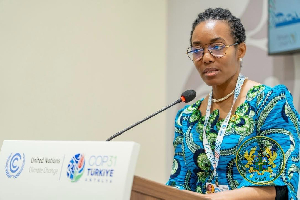
Ghana’s Environment Minister, Dr Zanetor Agyeman-Rawlings, has told COP31 that Africa is “not here to beg” but to demand that wealthy nations honour climate finance commitments and pay a fair price for the minerals powering the global energy transition, warning that anything less risks becoming “a new form of colonialism.”
Addressing the Africa Day Ministerial Segment at the 31st UN Climate Change Conference on Sunday, Agyeman-Rawlings called on African nations to unite behind a single negotiating voice on climate justice, equitable finance and fair trade terms for critical minerals. “Africa is not here to beg; it is here to demand that commitments be honoured,” she declared. “The world needs Africa’s minerals to secure its future. Africa needs the world to honour its commitments to the continent.”
The Mineral Paradox
At the centre of her address was the argument that Africa is being asked to supply the raw materials for the world’s green industrial revolution — lithium, cobalt, manganese and copper — without capturing a fair share of the value created. Africa holds nearly a third of the world’s critical mineral reserves, and global revenues from copper, nickel, cobalt and lithium could reach $16 trillion by 2050, yet Sub-Saharan Africa currently captures only a fraction of that value.
Agyeman-Rawlings called for a collective African position in negotiations over critical minerals, arguing that the continent must secure “greater economic benefits from its natural resources” rather than remaining “primarily an exporter of raw materials.” Her warning about “a new form of colonialism” was directed at climate policies that impose obligations on Africa without providing the means to meet them. Speaking at a high-level meeting between the UN Secretary-General and African heads of state, she said any approach that “disproportionately burdens Africa” or “undermines its sovereignty and limits its development aspirations” risks replicating colonial dynamics under a green banner.
The Finance Demands
Agyeman-Rawlings presented a set of concrete conditions she said must anchor Africa’s position in Antalya. First, she demanded a clear funding and accountability framework to deliver at least $120 billion in annual climate adaptation finance by 2035 — the tripling of adaptation finance agreed at COP30 in Belém. She said this must be backed by “an established funding baseline, clearly identified sources of finance and mechanisms to monitor disbursements.” “Africa’s case rests on one point: commitments already made must now be funded, tracked and delivered on fair terms,” she said.
Second, she insisted that African countries should reject new climate obligations without adequate financial, technological and capacity-building support. At the African Ministerial Conference on the Environment (AMCEN) meeting on the margins of COP31, she urged ministers to defend three red lines: no reversal of the Belém commitment to triple adaptation finance, no additional obligations without the means to implement them, and no double-counting of climate finance or excessive reliance on loans. “Finance must be predictable, grant-based or highly concessional, and must not deepen debt,” she said.
Third, she placed water security at the centre of Africa’s resilience agenda, describing access to reliable water resources as “fundamental to the continent’s survival and long-term development.” She also called for every African to have access to early warning systems and for the restoration of degraded ecosystems.
The Injustice Case
The moral foundation of her argument rested on a stark asymmetry. “Africa emits about four per cent of global greenhouse gases, but loses an estimated two to five per cent of its Gross Domestic Product every year due to climate extremes,” she said. “This is not misfortune; this is injustice.”
She cited the UN Environment Programme’s finding that the Fund for Responding to Loss and Damage opened with just $342 million against requests roughly eight times that amount. “Loss and damage is not charity. It is liability,” she said.
Ghana’s Credentials — and Its Ambitions
Agyeman-Rawlings did not come to Antalya only with demands. She offered Ghana’s experience as a template for African participation in carbon markets, announcing that Ghana had become the first African country to complete the full authorisation, issuance, transfer and reporting cycle for Internationally Transferred Mitigation Outcomes (ITMOs) under Article 6 of the Paris Agreement, transferring 34,705 ITMOs to Switzerland through a rural cookstove project.
She proposed a joint AMCEN–African Group of Negotiators peer-learning programme to help other African countries build national carbon registries and project approval systems. She also pledged Ghana’s support to the African Group of Negotiators and noted that Ghana is preparing to assume the expected chairmanship of the African Union in 2027 — positioning Accra to carry the continent’s climate priorities beyond COP31 into COP32 in Addis Ababa. “Our strength in Antalya is our unity,” she said. “Ghana will stand with the African Group of Negotiators Chair and with every African delegation until the final gavel.”
Who She Is
Agyeman-Rawlings, a medical doctor and the daughter of former President Jerry John Rawlings and former First Lady Nana Konadu Agyemang-Rawlings, has represented Klottey Korle in Parliament since 2017. President John Mahama nominated her as Minister for Environment, Science and Technology in August 2026, and she was sworn in on 29 August, bringing parliamentary experience on the Environment, Science and Technology Committee to a ministry whose mandate spans environmental governance, scientific research and technological innovation.
Her COP31 interventions — combative, technical and explicitly political — have marked her as one of the more assertive African voices at a summit where the continent’s central demand is not sympathy but payment. With COP31 running until 20 November, the question is whether Africa’s unified position — and Agyeman-Rawlings’ insistence that “every commitment already made must now be funded, tracked, and delivered on fair terms” — will translate into binding outcomes or another round of declarations without resources.
Get the AfroAsia Media newsletter
The day's top stories from Africa and Asia, straight to your inbox.
Comments
0 comments
Loading…