
UK government urges FIFA to ban Argentine players from World Cup final over Falklands banner
The British government has demanded that FIFA impose severe sanctions on the Argentine players who displayed a banner claiming sovereignty over the Falkland Islands after Wednesday’s World Cup semi-final victory over England, urging football’s global governing body to ban those involved from Sunday’s final against Spain. The political firestorm erupted after Argentina’s 2-1 comeback win…
Published 4 min read
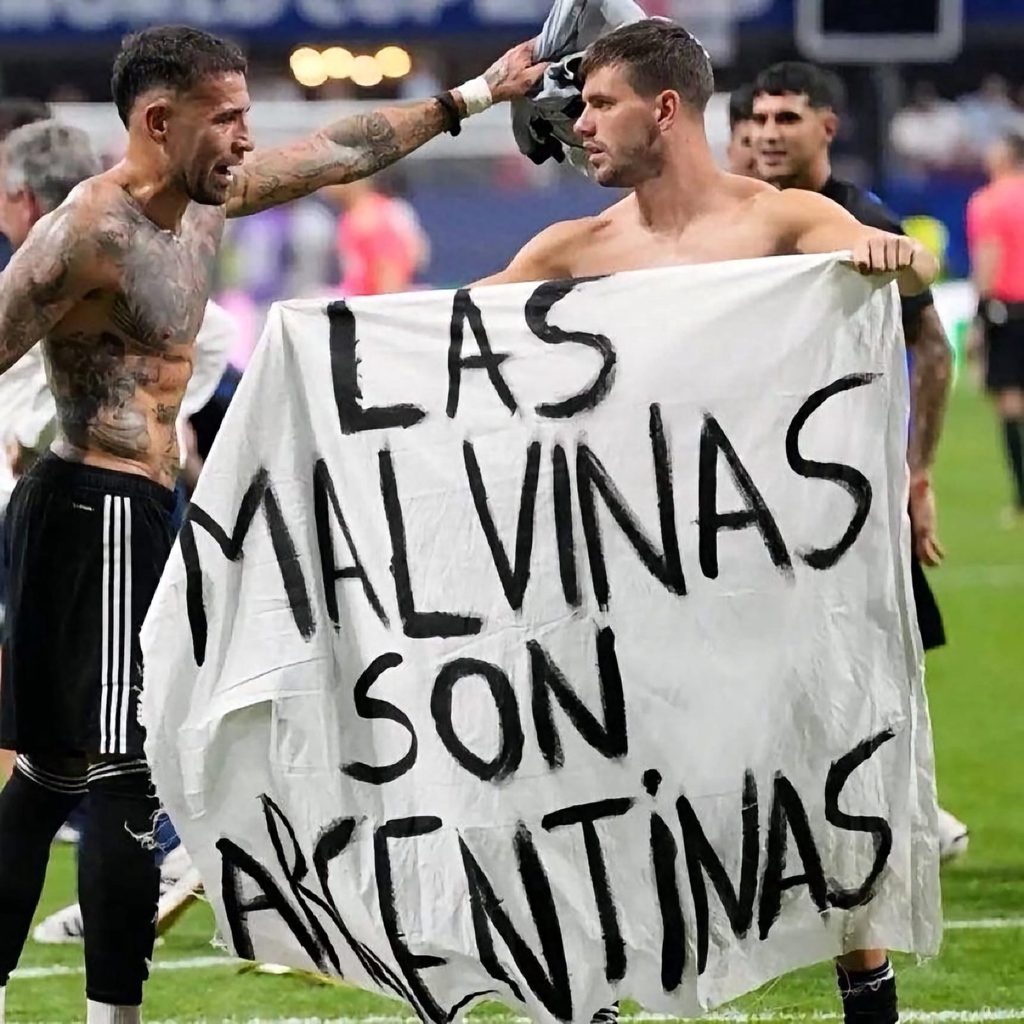
The British government has demanded that FIFA impose severe sanctions on the Argentine players who displayed a banner claiming sovereignty over the Falkland Islands after Wednesday’s World Cup semi-final victory over England, urging football’s global governing body to ban those involved from Sunday’s final against Spain.
The political firestorm erupted after Argentina’s 2-1 comeback win in Atlanta, when players including Lisandro Martínez, Giovani Lo Celso, and Cristian Romero posed with a banner reading “Las Malvinas son Argentinas” — “The Falklands are Argentine” — during post-match celebrations.
Government demands decisive action
Business Secretary Peter Kyle branded the display “entirely inappropriate” and an “egregious violation” of FIFA’s rules prohibiting political messaging on the field of play.
“I think [an investigation] is certain to happen because it was such an egregious violation of the rules of not having political activity as part of the football,” Kyle told BBC Breakfast.
Prime Minister Sir Keir Starmer’s Downing Street office backed the calls, with a spokesperson delivering a blunt riposte: “The World Cup might not be ours, but the Falkland Islands definitely are.”
“Our position is unchanged. Self-determination rests with the islanders and our commitment to the Falklands will never waver,” the spokesperson added.
Liberal Democrat leader Sir Ed Davey went further, explicitly calling for Argentine players who celebrated with the banner to “be barred from the final”. He pointed to the precedent of Spain players Álvaro Morata and Rodri being banned for one game by UEFA after they chanted “Gibraltar is Spanish” during their Euro 2024 victory celebrations.
Conservative Party leader Kemi Badenoch declared: “The Falkland Islands are British. The Conservatives will always defend them,” while Reform UK leader Nigel Farage said he was “disgusted” at the behaviour and called for Britain to “build up the Royal Navy quickly”.
FIFA opens formal investigation
FIFA has opened a disciplinary case and launched a full investigation into the incident, which appears to violate the tournament’s Stadium Code of Conduct banning “banners, flags, flyers, apparel and paraphernalia that are of a political, offensive, and/or discriminatory nature.”
The governing body’s disciplinary code prohibits at stadiums any “message that is not appropriate for a sports event” including those of “a political, ideological, religious or offensive nature.”
FIFA fines for political messaging typically range from $5,000 to $20,000. However, the UK government is pushing for player suspensions that could rule individuals out of Sunday’s final.
Precedent suggests sanctions likely — but final ban uncertain
Argentina has previous form on this issue. In 2014, the Argentine Football Association was fined £20,000 after the national team displayed the same banner before a friendly against Slovenia.
FIFA has also previously banned a South Korea player for two 2014 World Cup qualifying games after he held up a similar banner about a territorial claim against Japan at the 2012 London Olympics.
Legal experts note that while sanctions are almost certain, a ban from the final itself remains unlikely. Past disciplinary cases have typically resulted in fines rather than match suspensions for such incidents.
Argentina defiant amid diplomatic row
Argentine President Javier Milei described the players’ celebration as “perfectly valid,” saying the message “reflects a sentiment shared by all Argentines.” However, he acknowledged he expected FIFA to impose a fine, telling a Buenos Aires radio station: “What the players do is understandable; they get carried away by their emotions, they act on impulse, and that will likely lead to discussions about a fine.”
Argentina vice-president Victoria Villarruel, who had stoked tensions before kick-off by posting that the semi-final was “about putting the invaders in their place,” wrote on X after the match: “The Falklands are Argentine. They banned bringing them to the stadium and forgot that we carry them in our blood and our hearts.”
Midfielder Leandro Paredes told reporters: “And they will always be Argentine. We were aware of what this match meant for the country. We tried to represent our nation and all those who lived through that sad moment in our history.”
However, manager Lionel Scaloni had attempted to distance himself from politics before the match, stating he was “not going to mix” football and politics. “It was a very sad period in our history, and there isn’t much we can do about it, that’s the reality,” Scaloni said.
A rivalry steeped in history
The banner references the 1982 Falklands War, a 74-day conflict that claimed the lives of 255 British servicemen, 649 Argentine personnel, and three islanders. The islands remain a British Overseas Territory, with its 3,500 residents voting overwhelmingly in a 2013 referendum — 1,513 to three — to remain British.
The dispute dates back to 1833, when Britain sent a warship to expel Argentine forces who had sought to establish sovereignty over the territory.
What happens next?
FIFA’s disciplinary committee is expected to deliver its verdict before Sunday’s final, though any player suspensions would almost certainly be challenged by the Argentine Football Association.
For now, Argentina’s players remain eligible for the showpiece against Spain — but the political fallout from their celebration threatens to overshadow what should be sport’s greatest stage.
Get the AfroAsia Media newsletter
The day's top stories from Africa and Asia, straight to your inbox.




Comments
0 comments
Loading…