
The impossible repeat: Messi defies time with back-to- back World Cup masterclasses
– As the confetti settled on the 2026 World Cup final, statisticians and football historians were left scrambling for superlatives—and for a precedent that simply does not exist. Lionel Messi, at 39 years old, has done what no player in the history of the sport has even approached: he has delivered two consecutive World Cup…
Published 5 min read
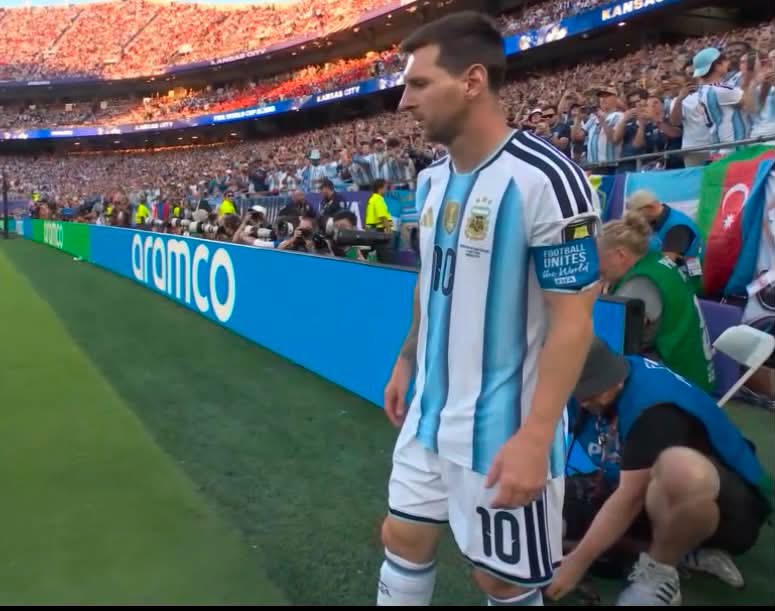
– As the confetti settled on the 2026 World Cup final, statisticians and football historians were left scrambling for superlatives—and for a precedent that simply does not exist. Lionel Messi, at 39 years old, has done what no player in the history of the sport has even approached: he has delivered two consecutive World Cup campaigns with double-digit goal contributions, separated by four years and an entire footballing generation.
Let that sink in. In Qatar 2022, a 35-year-old Messi dragged Argentina to glory with 7 goals and 3 assists across 7 matches—10 goal involvements, a tournament-high that earned him the Golden Ball. Fast forward to the 2026 edition, staged across the United States, Canada, and Mexico. This time, in just 6 matches, the ageless magician has surpassed his own output: 8 goals and 2 assists, tallying another 10 goal contributions, but at the remarkable efficiency of 1.66 per game—up from his 1.42 in 2022.
No other player in World Cup history—not Pelé, not Maradona, not Ronaldo or Zidane—has ever recorded 10 goal contributions in a single tournament after the age of 30. To do it twice, at 35 and 39, stretches the boundaries of physiological plausibility.
A Tale of Two Primes
In Qatar, Messi was the emotional captain, carrying a wounded nation on his back. His five penalties, his iconic dribble past Gvardiol to set up Álvarez, and his two goals in the final against France wrote the ultimate fairytale ending. At the time, pundits universally declared it the perfect swan song.
Four years later, with his hair greyer and his sprint now a measured glide, Messi has somehow become more devastating. In the 2026 group stage, he netted a hat-trick against a physical European side, each finish more clinical than the last—a far cry from the younger, dribble-heavy Messi. In the quarterfinal, with Argentina trailing, he provided a defense-splitting assist that covered 40 yards, a pass so precise that teammates joked it had “GPS coordinates.” His eight goals in the tournament included three from outside the box, a testament to a refined, long-range accuracy that has only sharpened with age.
“At 39, most players are picking their kids up from school, not picking apart the world’s best defenses,” remarked former England international and pundit Gary Lineker in a post-match analysis. “What we are witnessing is not just longevity; it is a complete re-invention of his game. The 2022 Messi relied on bursts. The 2026 Messi relies on a brain that processes the game three seconds faster than anyone else on the pitch.”
The Final Act That Defies Logic
The statistical anomaly is staggering. Across 13 World Cup matches spanning two tournaments, Messi has amassed 20 direct goal involvements—15 goals and 5 assists—averaging more than 1.5 per game. To put that in perspective, many legendary strikers fail to reach 10 goal contributions across their entire World Cup careers, spanning four or five tournaments.
Argentine teammates have revealed that Messi’s preparation for 2026 was almost monastic. He reportedly hired a team of sports scientists to focus exclusively on recovery, muscle elasticity, and sleep optimization, dropping his body fat to levels lower than during his Barcelona prime. His minutes on the pitch are now managed with surgical precision—yet in the 2026 final, he played all 120 minutes, scoring the opening goal and converting his penalty in the shootout.
“When you are 39, your legs go before your mind,” said Argentina’s manager, Lionel Scaloni, after the final whistle. “But Lionel’s mind has never been sharper. He knows where the ball will be before the opponent even decides to pass it. That is not human. That is a footballing intelligence that has been cultivated for two decades, now operating at its absolute zenith.”
The Ultimate Context
Historically, World Cup primes are fleeting. Pelé was 17 when he burst onto the scene but never replicated his 1958 fireworks at an older age. Maradona’s 1986 majesty was unmatched in 1990. Ronaldo’s 2002 resurgence was a miracle, but he didn’t repeat it.
Messi has not only repeated it—he has improved his goal tally while decreasing his match count. He has activated the greatest World Cup prime in history during the final stretch of a professional career that was already supposed to be in its twilight.
With this performance, he has not only cemented the debate over the Greatest of All Time—he has ended it. The question is no longer whether he is the best, but whether any athlete in any team sport has ever dominated the world’s biggest stage with such ruthless consistency at such an advanced age.
As the Estadio Azteca crowd gave him a standing ovation that lasted a full ten minutes, a tearful Messi embraced his family on the pitch. When asked how he kept finding the energy, he simply smiled and said, “I don’t know. I just love this shirt. And I told the young guys—age is just a number until you stop believing. I never stopped.”
History will record 2022 and 2026 as the twin peaks of a career that has spanned four decades. But for those who watched, the numbers—8 goals, 2 assists, 6 matches, 39 years old—will forever read as the most improbable, unrepeatable stat line the beautiful game has ever produced.
Get the AfroAsia Media newsletter
The day's top stories from Africa and Asia, straight to your inbox.




Comments
0 comments
Loading…