
MoMo vendor shoots, kills armed robber, recovers stolen GHC140,000 in Lashibi
A mobile money vendor fought back against two armed robbers in Lashibi, Greater Accra, on Thursday, shooting and killing one suspect and recovering the entire GH¢140,000 that had been snatched from his vehicle. The Ghana Police Service has confirmed the incident, stating that the two suspects, riding a motorbike, intercepted the vendor’s car along the…
Published 5 min read
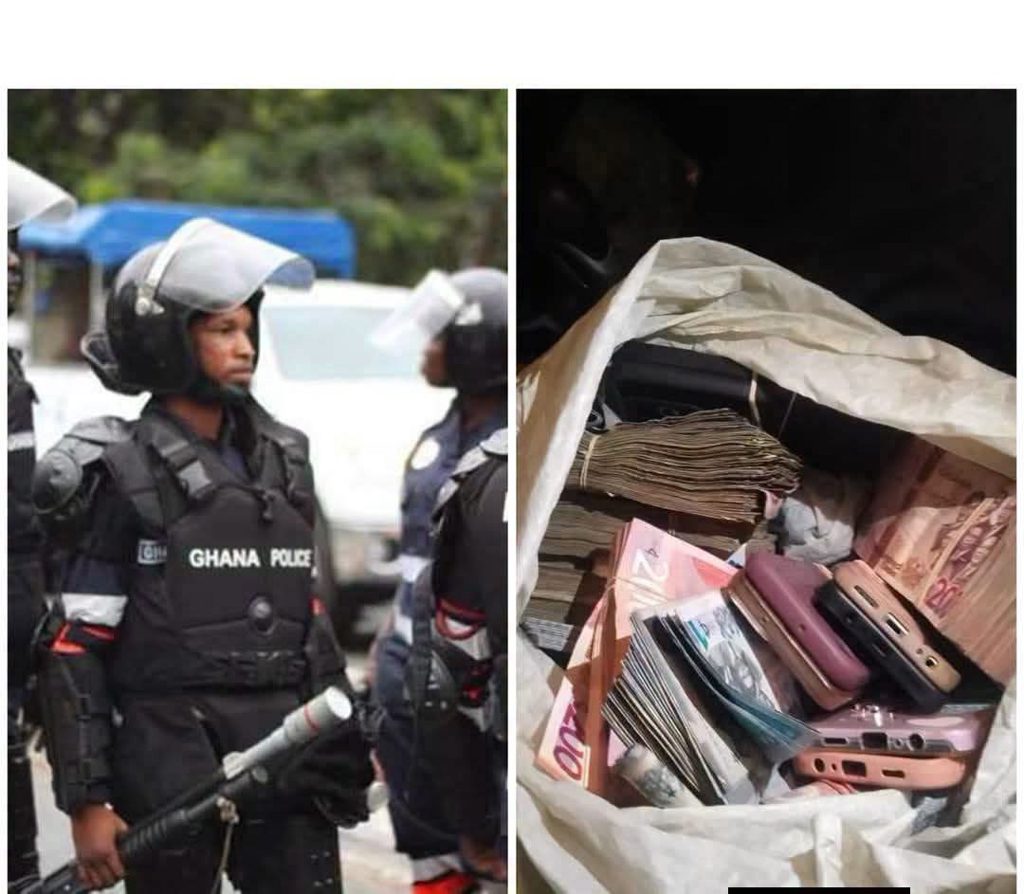
A mobile money vendor fought back against two armed robbers in Lashibi, Greater Accra, on Thursday, shooting and killing one suspect and recovering the entire GH¢140,000 that had been snatched from his vehicle.
The Ghana Police Service has confirmed the incident, stating that the two suspects, riding a motorbike, intercepted the vendor’s car along the Lashibi stretch. According to a police brief, the robbers fired at the vehicle, shattering the rear tyre and windshield, before forcefully grabbing a bag containing the cash.
In a dramatic turn, the vendor—who holds a valid firearm license and is permitted to carry a weapon for self-defence—returned fire as the suspects attempted to flee the scene. One suspect fell dead instantly. The second accomplice abandoned the bag of money and escaped on the motorbike, leaving behind the entire loot, which police later recovered intact. The vendor sustained no injuries.
A search of the deceased suspect’s body, identified as 46-year-old Innocent Elemuwa Akachukeu, yielded startling discoveries: an AK-47 rifle, two magazines loaded with 55 rounds of live ammunition, an additional 11 loose rounds, GH¢3,000 in cash, a Samsung mobile phone, and an identification card.
“The suspect was heavily armed and clearly prepared for a violent confrontation,” a senior police investigator told the Daily Graphic, speaking on condition of anonymity. “We are currently pursuing the second suspect and urge anyone with information to come forward.”
The incident has reignited public debate over the safety of mobile money vendors, who often carry large sums of cash and are increasingly targeted by armed gangs. The Vendor Association of Ghana has called for enhanced police patrols in robbery hotspots, while some members are now openly discussing the need for personal protection.
Police have commended the vendor for his composure but reminded the public that the use of lethal force must be proportionate and legally justified. Investigations are ongoing.
ANALYSIS: SHOULD MOMO VENDORS START ARMING THEMSELVES?
By Kwame Larweh
The Lashibi incident—where a mobile money vendor used a firearm to neutralise an armed robber and recover stolen funds—has thrust a thorny question into the national discourse: Should vendors, who routinely handle significant amounts of cash, begin arming themselves for protection?
At first glance, the outcome in Lashibi appears to be a victory: a law-abiding citizen successfully defended his life and property against violent criminals. Yet, this isolated success masks a web of legal, practical, and societal dangers that make widespread arming a profoundly risky proposition.
The Arguments for Arming
Proponents argue that mobile money vendors operate in high-risk environments—often isolated kiosks, roadside stands, or moving vehicles—with little to no police presence. The robbery at Lashibi is not an anomaly; police statistics show a steady rise in street robberies targeting cash-handling businesses. In such a climate, a firearm can serve as an equaliser against heavily armed gangs.
Furthermore, the psychological deterrent cannot be discounted. If criminals know vendors are potentially armed, they may think twice before attacking. The Lashibi case has already emboldened some vendors, who cite the incident as proof that armed self-defence is both viable and effective.
The Overwhelming Risks and Legal Hurdles
Yet, the arguments against arming are weightier and far more consequential.
First, legal constraints: Ghana’s Arms and Ammunition Act (Act 714) strictly regulates firearm ownership. Obtaining a licence is rigorous and expensive, requiring character checks, mental health evaluation, and proof of genuine need. Even if a vendor obtains a licence, carrying a weapon in public is subject to strict rules. Encouraging widespread arming would almost certainly lead to illegal firearms proliferation, as not all vendors can meet the legal threshold.
Second, escalation of violence: Introducing more guns into commercial transactions raises the stakes. A robber may react more aggressively if they expect their target to be armed. What begins as a snatch-and-grab could turn into a firefight with innocent bystanders caught in the crossfire. In the Lashibi case, the vendor fired into a public street—had his aim been off, a passerby could have been killed.
Third, training and composure: Handling a firearm under extreme stress requires training that most vendors do not possess. In a panic, a weapon can be turned against its owner, or used in a manner that legally constitutes excessive force. Even in the Lashibi case, police are still investigating whether the shooting was fully justified under the doctrine of self-defence, which requires the threat to be imminent and the response proportionate.
Fourth, societal cost: A culture of armed commerce normalises gun use and undermines the state’s monopoly on force. It could erode trust between citizens and police, as vendors might take the law into their own hands rather than call for help.
Safer Alternatives
Instead of rushing to arm themselves, vendors and policymakers should focus on proven, non-lethal security measures:
· Cash reduction strategies: Encouraging digital-to-digital transfers, using point-of-sale machines, and limiting physical cash holding to smaller amounts.
· Armed police escorts: The police service could establish dedicated mobile money security patrols in high-risk areas.
· Private security firms: Vendors can pool resources to hire professional guards who are better trained and insured.
· Improved infrastructure: Better lighting, CCTV coverage, and visible police posts in commercial zones.
· Rapid response systems: A dedicated emergency hotline for vendors with GPS-enabled tracking could reduce response times.
The Bottom Line
The Lashibi shooting was a narrow case where a legally armed vendor, acting under extreme duress, managed to defend himself. But it is not a template for policy. Arming every mobile money vendor would create more problems than it solves—legal violations, accidental shootings, escalating criminal tactics, and a creeping militarisation of daily commerce.
Rather than turning vendors into gun-toting civilians, we should demand that the state honour its primary duty: protecting citizens through effective policing and swift justice. If the state fails, the answer is not vigilante justice but civic pressure for better security infrastructure.
For now, vendors should prioritise safety training, cash minimisation, and collaboration with law enforcement. A gun in a vendor’s hand is not a solution—it is a symptom of a deeper failure we must collectively address.
Get the AfroAsia Media newsletter
The day's top stories from Africa and Asia, straight to your inbox.




Comments
0 comments
Loading…