
Mahama addresses Jamaican Parliament, calls for reparatory justice and honours shared African heritage
President John Dramani Mahama on Tuesday delivered a historic address before a joint sitting of Jamaica’s House of Representatives and Senate in Kingston, using the occasion to deepen bilateral ties, honour the shared struggles of African descendants, and renew calls for reparatory justice. The Ghanaian leader was formally received into the Chamber by Speaker of…
Published 4 min read
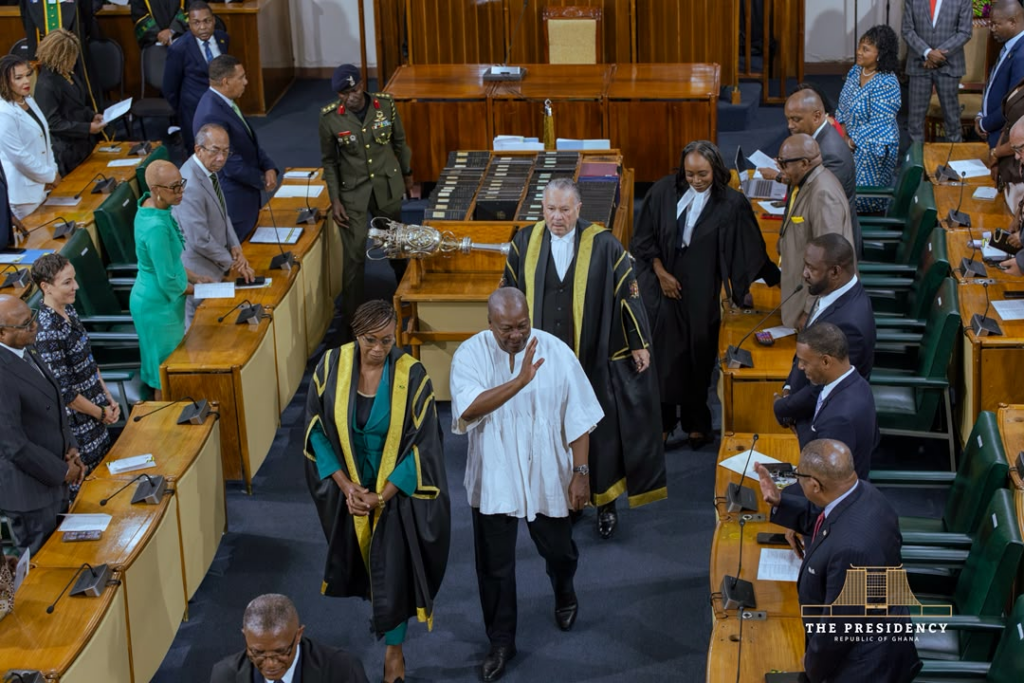
President John Dramani Mahama on Tuesday delivered a historic address before a joint sitting of Jamaica’s House of Representatives and Senate in Kingston, using the occasion to deepen bilateral ties, honour the shared struggles of African descendants, and renew calls for reparatory justice.
The Ghanaian leader was formally received into the Chamber by Speaker of the House Juliet Holness and Senate President Thomas Tavares-Finson, with Prime Minister Andrew Holness also in attendance. The address coincided with Jamaica’s commemoration of Emancipation Day and its 64th Independence Day anniversary—a dual celebration that Mahama described as a powerful testament to the island nation’s enduring spirit.
A Shared History of Resistance and Resilience
In his speech, Mahama declared that Ghana was proud to have been among the first countries to recognise Jamaica’s independence in 1962. He framed the twin celebrations as more than national holidays, calling them “endurance symbols of humanity’s determination to overcome oppression and reclaim dignity.”
“The story of Jamaica is in many respects the story of Africa,” he said, tracing the lineage from the great African empires—Ghana, Mali, Songhai, Great Zimbabwe, Buganda, Ashanti, Benin, and Ile-Ife—through the horrors of the Middle Passage and enslavement, to the resilience of communities that preserved their identity and faith against all odds.
He paid special tribute to the Maroon communities in Jamaica, noting that their resistance mirrored the liberation movements that later swept across Africa, ultimately giving birth to free nations determined to shape their own destinies.
Honouring the Ancestors, Confronting History
“Today we honour the enslaved men and women whose labour enriched empires while their humanity was denied them. We honour those who resisted injustice. We honour those who fought for emancipation, self-determination and national liberation,” Mahama stated.
He stressed that freedom is never given but earned through sacrifice, sustained by vigilance, and strengthened by unity. However, he insisted that honouring the past requires honesty: “History cannot be changed, but it can be acknowledged. Only by acknowledging historical truth can we build a future founded on reconciliation, justice, and mutual respect.”
Renewed Call for Reparatory Justice
Citing the UN General Assembly’s recent reaffirmation that the Trans-Atlantic Slave Trade and racialised enslavement of Africans constitutes a grievous crime against humanity, Mahama argued that its consequences persist today in patterns of inequality and exclusion.
He made a strong case for reparatory justice, clarifying that the pursuit is not born of resentment or hostility, but of commitment to truth, accountability, and healing.
“It seeks recognition of historical wrongs, acknowledgement of the enduring consequences, and a collective determination to build a more just and equitable global order,” he said.
Mahama expressed Ghana’s profound appreciation to Jamaica for its unwavering support of Ghana’s UN initiative that led to Resolution A/RES/78/250, as well as its invaluable contribution to the Accra Next Steps Conference on Reparatory Justice. He praised Jamaica for providing principled leadership on the issue for many years.
A Vision of Unity and Hope
Turning to Prime Minister Holness’s impending petition to King Charles III on slavery, Mahama offered a nuanced perspective: while the injustices of history must never be forgotten, they must not imprison future generations.
He reminded the chamber that the story of people of African descent is not solely one of suffering—it is equally one of resilience, excellence, and enduring achievement. He pointed to civilisations that advanced human knowledge, freedom fighters who challenged oppression, innovators in science and technology, artists who enrich global culture, and statesmen and women who inspire nations to believe in freedom and self-determination.
“Our advocacy is ultimately about hope—hope that our future generations will inherit a world where historical truth is acknowledged, human dignity is upheld, and justice becomes the foundation for lasting reconciliation,” he concluded.
Diplomatic Significance
The address marks a high point in Mahama’s state visit to Jamaica, reinforcing the historical and cultural bonds between the two nations. It also underscores Ghana’s growing role as a diplomatic voice for the African diaspora and its commitment to advancing conversations on reparative justice on the global stage.
Ghana and Jamaica share deep historical ties, with both nations rooted in the transatlantic slave trade and later independence movements. The visit is expected to yield further cooperation agreements in trade, culture, and education, building on the foundational relationship that Mahama characterised as “a vision worthy of our ancestors” and one to which Ghana remains unwaveringly committed.
Get the AfroAsia Media newsletter
The day's top stories from Africa and Asia, straight to your inbox.




Comments
0 comments
Loading…