
’Let’s end Accra’s flood cycle’ —Mahama orders post-flood relief as death toll rises to nine
President John Dramani Mahama has directed the Minister of Finance to immediately release funds from the government’s Contingency Fund to support thousands of residents affected by the devastating floods that swept through parts of the Greater Accra Region, destroying homes, businesses and public infrastructure. The directive followed the President’s aerial assessment of flood-ravaged communities after…
Published 5 min read
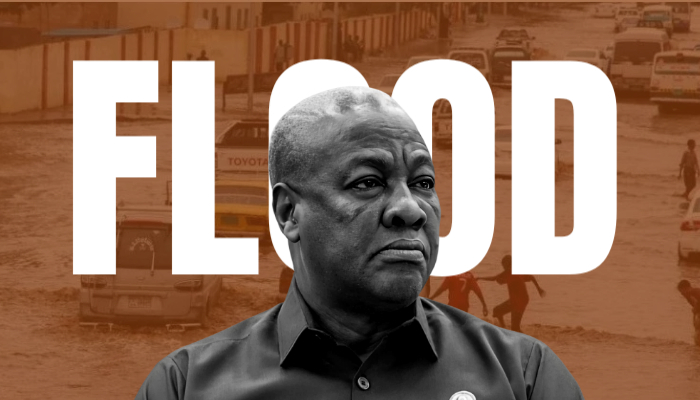
President John Dramani Mahama has directed the Minister of Finance to immediately release funds from the government’s Contingency Fund to support thousands of residents affected by the devastating floods that swept through parts of the Greater Accra Region, destroying homes, businesses and public infrastructure.
The directive followed the President’s aerial assessment of flood-ravaged communities after torrential rains submerged several parts of the capital on Monday, leaving at least nine people dead, displacing families and causing extensive damage to property.
Expressing sympathy to victims, President Mahama described the destruction caused by the floods as enormous and assured affected residents that government agencies would provide immediate relief while longer-term measures are pursued to address the perennial flooding challenge.
Extensive destruction
“I just want to express my sympathy with people who have lost property. Loss of property has been very extensive,” the President said after inspecting the affected areas from the air.
The aerial tour gave the President a bird’s-eye view of the scale of the disaster, with large swathes of the capital submerged under muddy floodwaters. From his vantage point, he observed rooftops barely visible above the waterline, submerged vehicles and residents stranded on higher ground awaiting rescue.
He commended the coordinated rescue efforts mounted by the security services and emergency response agencies, whose swift intervention saved numerous lives during the flooding.
President Mahama singled out the military, the Ghana Police Service, the Ministry of Works, Housing and Water Resources, the National Disaster Management Organisation (NADMO), and the 48 Engineers Regiment for their role in evacuating stranded residents from inundated communities.
“I’ve seen many of the videos where people had to be carried out of their houses. They deployed their boats, and they helped to save quite a lot of lives,” he said.
Videos circulating on social media showed rescue teams navigating flooded neighbourhoods in boats to evacuate children, the elderly and other vulnerable residents trapped in their homes. In some instances, rescuers were seen carrying elderly residents on their backs through chest-deep water to safety.
Relief package
To cushion victims against the immediate impact of the disaster, the President announced that the government would roll out emergency assistance through NADMO.
“NADMO will do what it can to try and identify the victims and see how we can just support them in a way in the next few days,” he said.
He disclosed that he had instructed the Minister of Finance, Dr. Mohammed Amin Adam, to release emergency funding without delay.
“I’ve asked the Minister of Finance to release some money from the contingency fund so that we can do some post-flood relief for persons who have been affected,” President Mahama stated.
The emergency package is expected to support displaced families with temporary shelter, food, essential household items and other humanitarian assistance while damage assessments continue. Government officials have indicated that the relief distribution would be prioritised for the most vulnerable, including pregnant women, nursing mothers, the elderly and persons with disabilities.
Permanent remedy
While acknowledging the immediate relief efforts, President Mahama stressed that Ghana must move beyond emergency responses and implement lasting solutions to Accra’s recurring flooding.
He urged citizens and public authorities alike to change their attitude towards flood prevention and infrastructure maintenance.
“Let me again express my sympathy, but let us change our attitude and let us find a permanent solution to this Accra flooding problem,” he said.
Drawing on a popular analogy, the President warned against the country’s tendency to postpone preventive measures until disaster strikes.
“We shouldn’t become like the vulture who, anytime it is raining, he says as soon as it stops raining, he will repair his roof. And then as soon as it stops raining, he says, wait, it will stop raining, so there’s no need to repair the roof. This time should be different,” he said.
The President’s remarks underscore a growing frustration among Ghanaians who have watched the capital flood with alarming regularity despite repeated promises of lasting solutions.
Recurring challenge
Monday’s torrential rains once again exposed the capital’s vulnerability to flooding, with major roads and residential communities submerged after several hours of heavy rainfall.
Communities including Alajo, Kaneshie, Circle, Adabraka, Weija, Odawna, parts of Tema, East Legon, Madina, Achimota, Kwame Nkrumah Circle, and surrounding areas experienced severe flooding, bringing traffic to a standstill and forcing many residents to abandon their homes.
In some areas, floodwaters rose to waist level within hours, catching residents off guard. Many were forced to seek refuge on rooftops or upper floors of their buildings as water levels continued to rise.
The Ghana National Fire Service has confirmed nine fatalities linked to the floods, with four of the deaths recorded in the Weija area, two in Alajo and three others in different parts of the capital. Rescue teams continue search, evacuation and recovery operations in affected communities, with fears that the death toll could rise as more reports come in.
Urban planners and disaster management experts have repeatedly attributed Accra’s persistent flooding to poor drainage systems, indiscriminate dumping of refuse into drains, uncontrolled development on waterways and rapid urbanisation.
Speaking to Graphic Sports, Dr. Kwaku Addai, an urban planning expert at the University of Ghana, described the situation as a “self-inflicted crisis.”
“We have built on wetlands, we have blocked our drains with plastic waste, and we have failed to maintain our drainage infrastructure. Until we address these fundamental issues, the floods will continue,” he said.
Government’s long-term vision
The government has indicated that alongside immediate relief efforts, it will intensify long-term interventions aimed at improving drainage infrastructure, enforcing planning regulations and reducing the city’s vulnerability to future flood disasters.
Sources close to the Ministry of Works, Housing and Water Resources have hinted that the government is considering a comprehensive review of Accra’s drainage master plan, with possible collaboration with international development partners to secure funding for major infrastructure projects.
There have also been calls for the demolition of structures built on waterways, a move that has proven politically sensitive in the past but which experts say is non-negotiable if Accra is to be saved from annual flooding.
President Mahama’s directive for emergency relief and his call for permanent solutions signal a renewed commitment to tackling the flooding menace that has plagued the capital for decades. Whether this time will indeed be different remains to be seen, but for the thousands of Ghanaians who have lost their homes and livelihoods, the hope is that the vulture analogy will finally be put to rest.
Get the AfroAsia Media newsletter
The day's top stories from Africa and Asia, straight to your inbox.




Comments
0 comments
Loading…