
ISSER questions slow pace of ‘Big Push’ as construction growth remains weak
The Institute of Statistical, Social and Economic Research (ISSER) has expressed serious concerns over the sluggish implementation of the government’s flagship ‘Big Push’ infrastructure programme, warning that the initiative is yet to translate into tangible economic activity despite its ambitious promises. Presenting ISSER’s review of the 2026 Mid-Year Budget, the Institute’s Director, Professor Robert Darko…
Published 4 min read
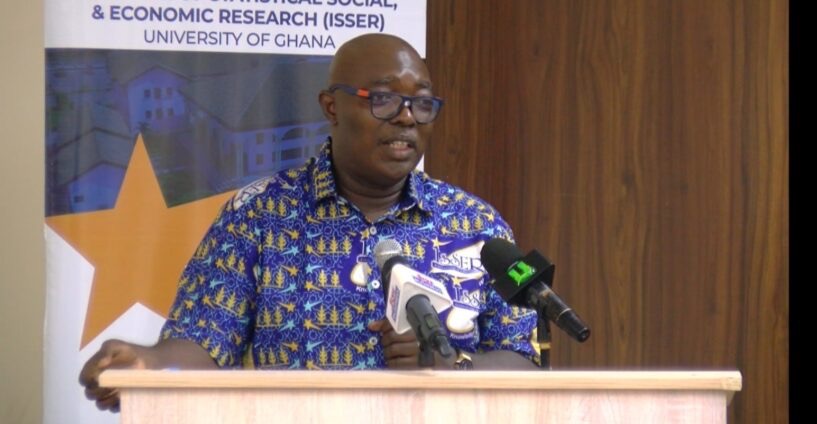
The Institute of Statistical, Social and Economic Research (ISSER) has expressed serious concerns over the sluggish implementation of the government’s flagship ‘Big Push’ infrastructure programme, warning that the initiative is yet to translate into tangible economic activity despite its ambitious promises.
Presenting ISSER’s review of the 2026 Mid-Year Budget, the Institute’s Director, Professor Robert Darko Osei, pointed to stark data showing that the construction sector—a primary beneficiary of infrastructure spending—grew by just 1.3% in the first quarter of 2026. This tepid performance, he argued, calls into question whether the much-touted programme is actually moving from blueprint to bulldozer.
“Construction grew by only 1.3% in 2026 Q1 despite the government’s Big Push Infrastructure Programme,” Prof. Osei stated. “This suggests that many projects may be at the preparatory or early implementation stages, and hence, have not yet translated into stronger measured construction growth.”
A Programme Built on Promise
The ‘Big Push’ was unveiled as a cornerstone of the government’s economic transformation agenda, designed to close Ghana’s infrastructure gap through massive investment in roads, bridges, schools, hospitals, and energy projects. The programme was billed as a catalyst for job creation, industrialisation, and long-term productivity gains.
However, ISSER’s analysis suggests that nearly a year after its launch, the programme’s impact on the ground remains minimal—raising questions about procurement bottlenecks, financing constraints, and project execution capacity.
Fiscal Restraint Blamed for Slowdown
ISSER attributed the weak construction performance partly to the government’s continued fiscal consolidation strategy. While tight expenditure controls have helped stabilise the macroeconomy—reducing inflation and improving the fiscal balance—they have also sharply curtailed capital spending.
“It also reflects the tight fiscal policy stance of the government—CAPEX decline was massive,” Prof. Osei noted. “Government is maintaining tight expenditure controls with no supplementary appropriation.”
The Institute revealed that capital expenditure in the first half of 2026 was 41% below target, a figure that underscores the tension between fiscal discipline and development spending. Without a supplementary budget to unlock additional funds, many infrastructure projects remain stalled or proceeding at a crawl.
The Broader Economic Context
The slow construction growth comes at a time when Ghana’s economy is showing tentative signs of recovery from a prolonged fiscal crisis. Inflation has eased, the cedi has stabilised, and the government has successfully renegotiated debt terms with international creditors.
However, ISSER warned that these gains could be short-lived if the real economy—particularly construction, manufacturing, and agriculture—does not pick up steam. Infrastructure investment is widely recognised as a multiplier for economic activity, creating demand for materials, labour, and transportation.
“Maintaining fiscal discipline is important,” Prof. Osei stressed, “but the government must ensure infrastructure investment gathers pace to support economic growth, create jobs, and improve productivity across the economy.”
Capital Expenditure: A Persistent Challenge
The 41% shortfall in capital expenditure is not an isolated incident. ISSER noted that similar underperformance occurred in previous years, suggesting a systemic issue with budget execution, particularly in the public works sector.
Challenges cited by analysts include:
· Slow procurement processes – Bureaucratic delays in awarding contracts.
· Cash flow constraints – Payments to contractors are often delayed, halting progress.
· Technical capacity gaps – Limited engineering and project management expertise within implementing agencies.
· Land acquisition disputes – Delays in securing land for major projects.
These factors, combined with the government’s cautious fiscal stance, have created a perfect storm of slow implementation.
What Needs to Change?
ISSER’s review offers several recommendations:
- Increase budget allocation to capital projects in the medium term, even while maintaining fiscal discipline.
- Streamline procurement and project approval processes to accelerate execution.
- Enhance monitoring of infrastructure projects to identify bottlenecks early.
- Explore alternative financing such as public-private partnerships (PPPs) to supplement government funds.
The Institute also called for greater transparency in reporting project milestones, so that citizens and investors can track progress against promises.
Government’s Response
The Ministry of Finance has not yet issued a formal response to ISSER’s critique. However, officials have previously argued that the ‘Big Push’ is a multi-year programme and that early-stage projects naturally take time to show results on the ground. They have also pointed to ongoing road and energy projects as evidence of progress.
Critics, however, note that the programme’s branding as a “Big Push” suggested urgency and scale—and that a 1.3% growth rate in construction hardly reflects a transformative effort.
A Crossroads for Economic Policy
The ISSER report highlights a fundamental policy dilemma for Ghana: how to balance the need for fiscal stability with the imperative of infrastructure-led growth. While austerity has restored investor confidence, it has also starved the real economy of the public investment needed to drive job creation and long-term productivity.
As the 2026 Mid-Year Budget review continues, policymakers face growing pressure to accelerate the ‘Big Push’—or risk turning a promising slogan into a missed opportunity.
The Road Ahead
For now, the construction sector remains stuck in low gear. Whether the government can shift into higher gear without reigniting fiscal pressures will define the success—or failure—of its flagship infrastructure agenda. ISSER has made its concerns clear. The next move lies with the Ministry of Finance.
Get the AfroAsia Media newsletter
The day's top stories from Africa and Asia, straight to your inbox.




Comments
0 comments
Loading…