
ISSER questions cost of fiscal stabilisation as CAPEX misses target by 41%
Ghana’s improving fiscal performance may be masking a growing threat to the country’s long-term economic prospects, the Institute of Statistical, Social and Economic Research (ISSER) has warned. In its assessment of the 2026 Mid-Year Budget Review, the Institute argued that the government’s stabilisation efforts are being driven largely by sharp cuts in spending rather than…
Published 5 min read
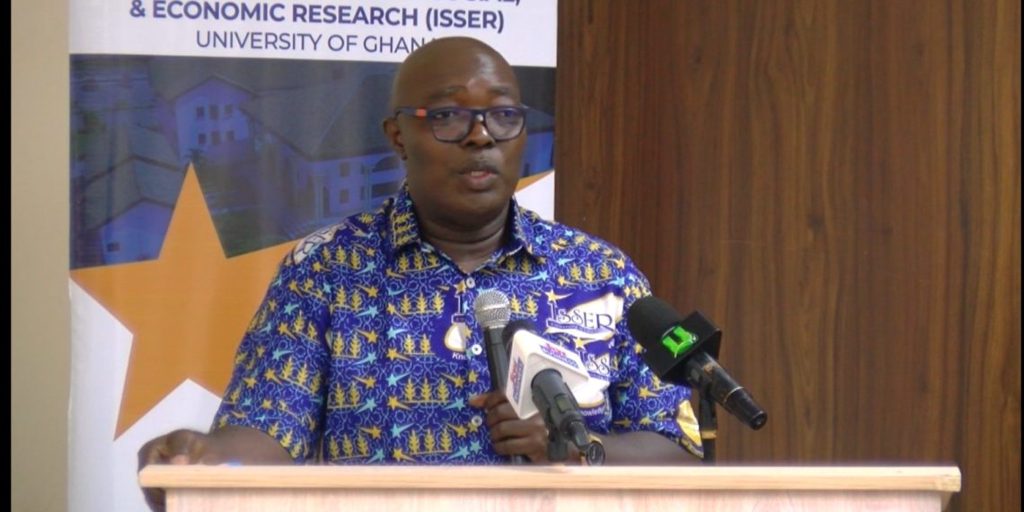
Ghana’s improving fiscal performance may be masking a growing threat to the country’s long-term economic prospects, the Institute of Statistical, Social and Economic Research (ISSER) has warned. In its assessment of the 2026 Mid-Year Budget Review, the Institute argued that the government’s stabilisation efforts are being driven largely by sharp cuts in spending rather than stronger revenue mobilisation—a strategy it says carries significant risks for future growth.
Presenting the review, ISSER Director Professor Robert Darko Osei cautioned that while the government has broadly met its fiscal targets, the quality of the adjustment raises important questions about sustainability.
“The question you need to ask is: how were those targets achieved?” Prof. Osei said, urging policymakers to look beyond the headline fiscal numbers.
Revenue vs. Expenditure: A Telling Gap
According to ISSER’s analysis, total revenue and grants narrowly missed target by just 1.03% during the first half of 2026—indicating that domestic revenue mobilisation remained largely on track, albeit slightly below expectations.
Government expenditure, however, tells a different story. Total spending was 20.6% below budgeted levels, suggesting that Ghana’s improved fiscal position was achieved primarily through expenditure restraint rather than stronger revenue performance.
“Revenue targets were missed by only about one percent. But expenditure was significantly lower than programmed,” Prof. Osei noted.
Capital Expenditure: The Hardest Hit
The sharpest reduction occurred in capital expenditure—spending on infrastructure, equipment, and other productive investments that support long-term economic expansion.
The government had budgeted approximately GH¢36.6 billion for capital projects during the first half of the year but spent only about GH¢21.7 billion, leaving capital expenditure roughly 41% below target.
For ISSER, that trend poses significant risks.
“Capital expenditure is critical for growth and development. We planned to spend GH¢36 billion, but only spent about GH¢21 billion in the first half of the year,” Prof. Osei said.
The ‘Big Push’ in Question
The slowdown in capital spending raises serious questions about the implementation of the government’s flagship ‘Big Push’ infrastructure programme, which has been promoted as a central pillar of the country’s economic transformation strategy.
“The delayed capital expenditure goes against the Big Push programme that government has emphasised,” Prof. Osei observed.
The warning comes amid weak performance in the construction sector, which expanded by only 1.3% in the first quarter of 2026—despite the ambitious infrastructure agenda. ISSER says the subdued growth suggests many planned projects remain at early stages of implementation and are yet to generate meaningful economic activity or job creation.
The Cost of Stabilisation
While acknowledging that expenditure restraint has helped the government outperform programme targets on the fiscal deficit and primary balance, ISSER cautions against relying excessively on spending cuts to achieve macroeconomic stability.
“The first-half fiscal performance has largely been driven by lower-than-budgeted expenditure. Revenue mobilisation has not performed particularly strongly,” Prof. Osei said.
“The key question is: at what cost? Capital expenditure was the hardest hit, and that raises serious questions about the cost of stabilisation.”
Broader Economic Implications
Prolonged underinvestment in infrastructure could:
· Weaken Ghana’s productive capacity – Roads, energy, and water systems are essential for business operations.
· Delay job creation – Construction and related industries are major employers.
· Constrain future economic growth – Even as macroeconomic indicators improve, the real economy may stagnate.
· Increase long-term fiscal pressure – Deferred maintenance and delayed projects often cost more later.
ISSER argues that stabilisation achieved through persistent cuts in capital expenditure could ultimately undermine the very growth needed to secure lasting fiscal sustainability.
Historical Context: Fiscal Consolidation in Ghana
Ghana has been under an IMF-supported programme since 2023, requiring stringent fiscal discipline to restore debt sustainability. The government has made progress—reducing the fiscal deficit, lowering inflation, and stabilising the cedi.
However, similar consolidation episodes in other developing countries have shown that austerity without investment can lead to a “growth trap”—where fiscal metrics improve, but economic activity slows, making future revenue generation harder.
What Needs to Change?
ISSER’s review offers several recommendations:
- Protect capital expenditure even while maintaining fiscal discipline, perhaps by ring-fencing a minimum percentage of the budget for infrastructure.
- Improve revenue mobilisation – Expand the tax base, enhance compliance, and reduce exemptions to reduce reliance on spending cuts.
- Accelerate project implementation – Streamline procurement and address bottlenecks to ensure that allocated funds are actually spent.
- Prioritise high-impact projects – Focus on investments with the greatest multiplier effects on employment and productivity.
Government’s Position
The Ministry of Finance has not yet issued a detailed response to ISSER’s critique. However, officials have previously argued that fiscal consolidation is a necessary short-term sacrifice to restore macroeconomic stability, and that infrastructure spending will ramp up as the economy stabilises.
Critics, however, note that the gap between budgeted and actual capital expenditure has persisted for several years—raising doubts about whether the “Big Push” will ever gain momentum.
A Crossroads for Economic Policy
The ISSER report highlights a fundamental policy dilemma: how to balance the need for fiscal discipline with the imperative of infrastructure-led growth. While austerity has restored investor confidence, it has also starved the real economy of the public investment needed to drive job creation and productivity.
As the 2026 Mid-Year Budget review continues, policymakers face growing pressure to accelerate capital spending—or risk turning a promising stabilisation story into a missed opportunity for transformation.
The Bottom Line
Ghana’s fiscal numbers may look better on paper, but ISSER warns that the cost—slashed infrastructure investment—could prove too high. The challenge now is to find a sustainable middle ground: fiscal prudence without sacrificing the future.
Get the AfroAsia Media newsletter
The day's top stories from Africa and Asia, straight to your inbox.




Comments
0 comments
Loading…