
Invest in Ghana, produce here and grow with us – Ato Forson woos local, foreign investors
Finance Minister Dr Cassiel Ato Baah Forson has urged local and international investors to establish businesses, expand production and create jobs in Ghana, assuring them of the government’s…
Journalist
Published 7 min read
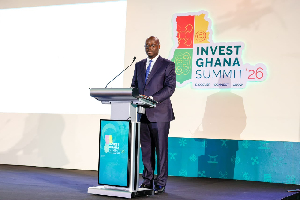
Finance Minister Dr Cassiel Ato Baah Forson has urged local and international investors to establish businesses, expand production and create jobs in Ghana, assuring them of the government’s commitment to maintaining macroeconomic stability and providing the infrastructure needed to support long-term investments.
He said Ghana was positioning itself as a competitive production and export destination, with opportunities for businesses to serve both the domestic market and the wider African continent.
Speaking at the maiden Invest Ghana Summit 2026 in Accra on Monday, November 16, Dr Forson called on investors to take advantage of the government’s New Economy Programme, which is backed by a planned US$10 billion public investment over four years, from 2027 to 2030.
“Invest in Ghana, produce here and grow with us,” he told participants, emphasising the need to move beyond importing finished products towards producing more goods locally and processing the country’s natural resources into higher-value products.
The Finance Minister said the government’s investment programme was intended to create the conditions for private businesses to expand, improve productivity and generate sustainable employment.
Under the programme, government plans to invest approximately US$2.5 billion annually in strategic sectors, with more than US$2.5 billion earmarked for 2027.
Dr Forson explained that public investments in electricity, irrigation, roads and other critical infrastructure would help reduce production costs and make businesses more competitive.
He identified macroeconomic stability, affordable financing, commercial agriculture, energy infrastructure, critical minerals processing, manufacturing, tourism, pharmaceuticals and technology as important pillars of the government’s economic transformation agenda.
Agriculture and manufacturing present major opportunities
The Minister identified agriculture and agro-processing as areas with considerable investment potential, particularly in rice, sugar, storage, milling and packaging.
He said the planned rice hubs would create opportunities for investors in irrigation systems, warehouses, processing facilities and packaging businesses.
Government is also proposing that public institutions purchase Ghana-grown rice and other locally produced staples, creating a potentially significant market for domestic producers.
Dr Forson said companies capable of meeting quality standards and supplying products consistently could develop sustainable businesses around the anticipated demand.
He encouraged investors to establish partnerships with farmers and other players in the agricultural value chain to guarantee reliable supplies of raw materials for processing facilities.
On energy, he said improved electricity supply would enable factories to maximise the use of their existing machinery, operate additional shifts and increase production.
He also identified opportunities in renewable energy, particularly solar power and battery storage, as well as the supply and maintenance of industrial power systems.
“A second shift means more output and more jobs,” he said.
The Minister further highlighted opportunities in garment and textile production, pharmaceuticals and other manufacturing activities where Ghanaian companies could meet domestic demand while building capacity to export to neighbouring countries.
Government targets local processing of minerals
Dr Forson said government was establishing a critical minerals processing enclave in the Western Region to attract investors interested in processing Ghana’s mineral resources locally.
The initiative is expected to provide opportunities for businesses to establish facilities that transform raw manganese and bauxite into higher-value industrial products.
He said the objective was to retain more economic value from the country’s natural resources instead of relying heavily on the export of unprocessed commodities.
The development forms part of the government’s broader industrialisation strategy, which seeks to expand domestic manufacturing, strengthen supply chains and create more employment opportunities.
Ghana’s mineral resources, including gold, manganese and bauxite, provide a significant opportunity for investment in processing, refining and related industrial services.
However, developing these industries will require substantial capital, reliable energy supplies, modern technology and long-term financing.
Dr Forson therefore urged financial institutions and development finance partners to work with project sponsors to structure financing arrangements that would make commercially viable investments possible.
AfCFTA offers access to wider African market
The Finance Minister also urged investors to consider Ghana’s strategic position as a gateway to the African market when deciding where to establish production facilities.
He said businesses operating in Ghana could take advantage of the African Continental Free Trade Area (AfCFTA) to reach customers across the continent.
“Your first customer may be in Ghana. Your next market could be anywhere on the continent,” he said.
Ghana hosts the AfCFTA Secretariat in Accra, placing the country at the centre of efforts to establish a single continental market covering approximately 1.4 billion people.
The agreement is designed to reduce trade barriers, improve the movement of goods and services and encourage African countries to develop regional value chains.
For manufacturers, the arrangement offers an opportunity to establish production facilities in Ghana and serve markets beyond the country’s borders.
Dr Forson encouraged Ghanaian businesses to bring forward expansion proposals and urged foreign investors to form partnerships with local companies that understood the domestic market.
He said such partnerships would help build local capacity, transfer technology and create opportunities for Ghanaian suppliers and workers.
Fiscal discipline key to investor confidence
The Minister stressed that maintaining macroeconomic stability would remain central to the government’s efforts to attract long-term investment.
He said businesses needed a predictable economic environment to price contracts, secure financing, plan production and make investment decisions.
“Fiscal discipline will protect the stability that allows you to price a contract, finance a factory and invest for the long term,” he said.
His comments come as Ghana seeks to consolidate the economic recovery following years of high inflation, currency depreciation, rising public debt and the debt restructuring exercise.
The government has indicated that the next phase of its economic programme will focus on translating macroeconomic stability into productive investment, industrial expansion and employment creation.
The 2027 Budget, presented by Dr Forson to Parliament on November 12, outlines the New Economy Programme as a four-year investment strategy aimed at increasing domestic production, expanding exports and strengthening the productive sectors.
The budget also identifies reforms to the tax system and measures to support businesses investing in machinery, production inputs and additional shifts under the 24-Hour Economy Programme.
Dr Forson said the government remained committed to supporting projects capable of expanding production, creating jobs and strengthening Ghana’s competitiveness.
Invest Ghana Summit attracts international business community
The Finance Minister’s appeal was made at the maiden Invest Ghana Summit, held at the Kempinski Gold Coast City Hotel in Accra from November 16 to 17, 2026.
The summit, organised under the theme, “Investing in Ghana’s New Economy: Building a Productive Economy that Creates Value and Competes Globally”, brought together government officials, international investors, financial institutions, corporate executives and Ghanaian entrepreneurs.
According to the summit’s organisers, the event was expected to attract more than 1,500 delegates from over 40 countries, with more than 100 vetted investment projects presented for consideration.
The gathering was designed to facilitate business-to-business and business-to-government engagements, connect investors with local enterprises and accelerate discussions on strategic investment partnerships.
President John Dramani Mahama, who hosted the summit, also called on businesses to invest in agriculture, agro-processing, mineral processing, logistics, energy, tourism, healthcare and digital services.
He emphasised that government alone could not build the productive capacity needed to transform the economy, stressing that the private sector would have to play a leading role in establishing factories, expanding production and creating jobs.
Among the opportunities highlighted at the summit were the Volta Economic Corridor, the Legon Pharmaceutical Innovation Park, the Kumasi Machinery and Technology Park, the Akosombo-Juapong Garments and Textiles Park and the Tamale Air Cargo Hub.
Dangote Group considers major investments in Ghana
One of the major investment developments emerging from the summit was the disclosure by Nigerian billionaire businessman Aliko Dangote that his group was in discussions with the Ghanaian government to establish sugar and cocoa processing factories.
The proposed investments could create approximately 50,000 jobs each, according to Mr Dangote, although discussions on the ownership arrangements and participation of Ghanaian investors were still ongoing.
The proposed projects underline the potential for large-scale private investment in Ghana’s agricultural and manufacturing sectors.
President Mahama has also urged businesses to establish stronger relationships with farmers by providing reliable markets for agricultural produce.
He argued that farmers would be encouraged to increase production when they had confidence that processors and other buyers would purchase their harvests.
The President said investments in processing facilities, storage infrastructure and transportation would be critical to building stronger agricultural value chains.
Call for concrete investment commitments
Dr Forson urged participants not to allow the summit to end with discussions and expressions of interest alone, but to pursue concrete investment partnerships and projects.
He encouraged investors to identify local partners, examine available projects and engage financial institutions to determine the requirements for financing viable businesses.
“I would like you to leave Accra with a partner you can call, a project you can examine and a meeting in the diary,” he said.
He reiterated that the government’s objective was to create an environment in which Ghanaian businesses could grow, foreign investors could establish sustainable operations and local industries could compete in regional and international markets.
The Minister’s appeal forms part of the government’s broader ambition to shift Ghana’s economy towards production, value addition and export-led growth, with the private sector expected to play a central role in delivering the proposed transformation.
Get the AfroAsia Media newsletter
The day's top stories from Africa and Asia, straight to your inbox.
Comments
0 comments
Loading…