
GRIDCO gives Ejisu occupants under high-tension lines 30 days to vacate
The Ghana Grid Company Limited (GRIDCo) has commenced a sensitisation and eviction exercise in the Ashanti Region to clear all human activities and structures from areas under its high-voltage transmission lines, giving residents, traders, artisans and commercial drivers operating under the lines at Ejisu a 30-day ultimatum to vacate. The Exercise The exercise, which is…
Published 5 min read
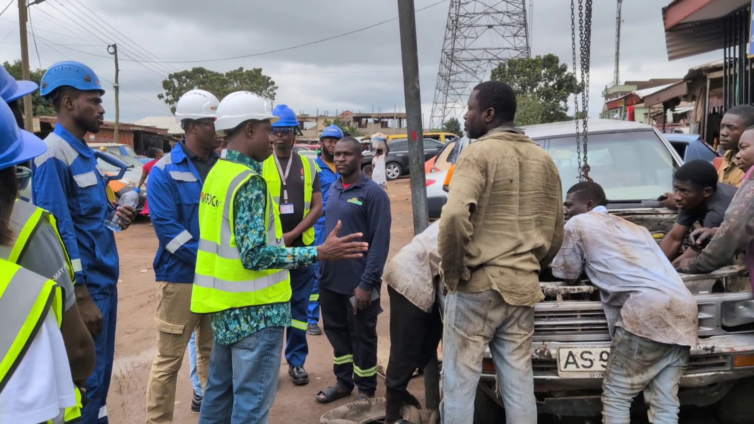
The Ghana Grid Company Limited (GRIDCo) has commenced a sensitisation and eviction exercise in the Ashanti Region to clear all human activities and structures from areas under its high-voltage transmission lines, giving residents, traders, artisans and commercial drivers operating under the lines at Ejisu a 30-day ultimatum to vacate.
The Exercise
The exercise, which is being carried out in collaboration with relevant state agencies, is aimed at preventing encroachment on the transmission corridor, which poses serious safety risks to both lives and critical national infrastructure.
The directive follows a recent incident at Ashaiman in the Greater Accra Region where a fuel tanker exploded and parts of the tanker flew and dented one of GRIDCo’s transmission towers, underscoring the dangers posed by human activity within transmission corridors.
GRIDCo’s Position
Speaking to the media, the Director of Land Management at GRIDCo, Engineer Bismark Anane, said such incidents highlight the urgent need to keep the transmission corridor free from human activities, especially trading in highly flammable materials, to safeguard lives and property.
“The Minister for Energy issued the directive following a recent incident at Ashaiman where a fuel tanker exploded and part of it flew and dented one of the transmission towers. So, to prevent a recurrence of such incidents, a one-month period has been given for occupants living within the right-of-way of the transmission lines to vacate voluntarily,” he said.
According to him, continuous occupation of the Right of Way not only endangers the lives of encroachers but also compromises the integrity of GRIDCo’s transmission infrastructure and hinders safe access for routine maintenance and emergency repair works.
He noted that high-voltage transmission lines carry extremely high currents, and any close human activity within the corridor could result in electrocution, fire outbreaks, and widespread power disruptions.
He stressed that the enforcement is not intended to punish anyone but to enforce safety regulations and ensure reliable power transmission across the country.
Compensation Criteria
During an engagement with affected occupants, GRIDCo clarified that not all affected persons will automatically qualify for compensation.
Engineer Anane explained that compensation will only be considered for affected occupants who can produce proper and verifiable documentation establishing their legitimate interest in the land they occupy.
He said persons who settled in the area without lawful authority or official documentation cannot be compensated, as their occupation is considered illegal.
GRIDCo has therefore urged all occupants within the transmission corridor to take note of the 30-day notice and make the necessary arrangements to relocate before the enforcement of the directive.
Mixed Reactions from Occupants
Meanwhile, affected occupants have expressed mixed reactions to the directive. While some say they are ready to comply with the order, they are appealing to GRIDCo and the authorities to provide alternative places for them to relocate before any eviction or demolition is carried out.
Some blamed the Ejisu Municipal Assembly, saying they were allowed to settle and operate in the area for years despite the visible presence of the transmission lines and were even collecting tolls and levies from them.
“We have been here for over a decade. The Assembly collects tolls from us every day. If the area was unsafe, why did they allow us to stay and keep taking our money?” one trader asked.
Others claimed they occupied the area long before the transmission lines were installed and therefore want their circumstances to be considered on humanitarian grounds.
“We were here before the poles were erected. Our parents built these structures. Now they are telling us to leave within 30 days. Where do they expect us to go?” a resident said.
According to them, a forceful eviction without an alternative place will lead to loss of homes, collapse of businesses and livelihoods, as many of them depend solely on activities within the enclave for survival.
They have therefore appealed to the government to intervene to ensure a humane approach to the exercise.
Background
The Right of Way (RoW) of transmission lines is a legally designated corridor on either side of high-voltage power lines that must remain free of human activity and structures to ensure safety and unimpeded access for maintenance.
Encroachment on transmission corridors has been a persistent challenge for GRIDCo across Ghana, particularly in rapidly urbanising areas where demand for land and commercial space has led to the erection of structures, markets and other activities under and around high-tension lines.
GRIDCo has repeatedly warned that such encroachment poses severe risks, including electrocution, fire outbreaks, and damage to transmission towers that could trigger nationwide power outages.
In recent years, the company has embarked on several sensitisation and enforcement exercises in various parts of the country, including Accra, Tema, Kumasi and Takoradi, to clear its Right of Way.
The Ashaiman incident, in which a fuel tanker explosion sent debris flying into a transmission tower, has heightened concerns about the dangers of allowing flammable materials and human activity near critical power infrastructure.
What’s Next
GRIDCo says it will continue its sensitisation efforts in the Ashanti Region and other parts of the country as part of a broader strategy to protect its transmission corridors.
The company has urged all occupants within the transmission corridor to take the 30-day notice seriously and make arrangements to relocate before enforcement begins.
Affected occupants, meanwhile, say they are hoping for government intervention to ensure that any relocation is carried out humanely and with adequate support for those who will be displaced.
Get the AfroAsia Media newsletter
The day's top stories from Africa and Asia, straight to your inbox.




Comments
0 comments
Loading…