
Government ramps up northern cotton revival to feed Ghana’s textile industry
The government is intensifying its push to revive large-scale cotton production in the Northern Region, positioning the crop as the engine for a renewed farm-to-factory value chain that will supply Ghana’s growing textile and apparel industry. The commitment was made on Thursday, August 27, 2026, by the Minister for Trade, Agribusiness and Industry, Hon. Elizabeth…
Published 3 min read
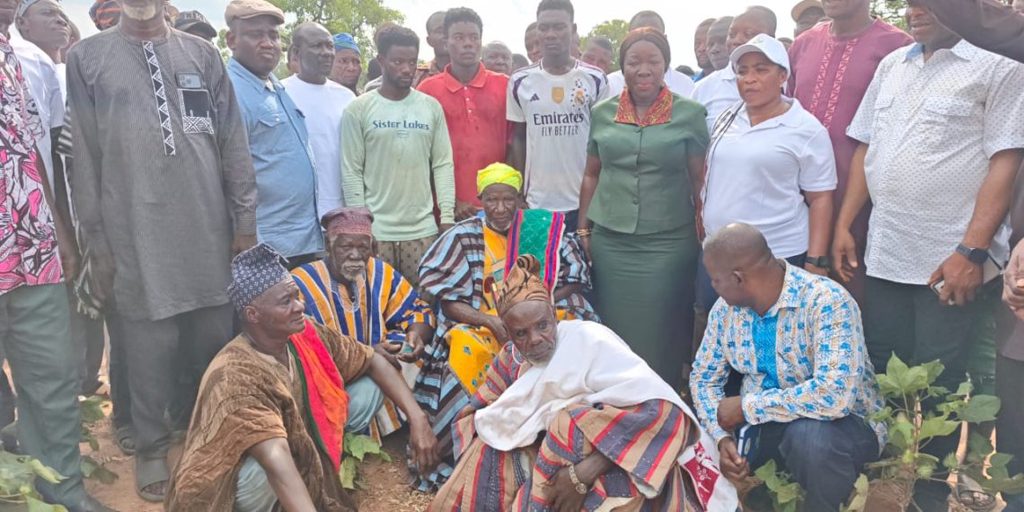
The government is intensifying its push to revive large-scale cotton production in the Northern Region, positioning the crop as the engine for a renewed farm-to-factory value chain that will supply Ghana’s growing textile and apparel industry.
The commitment was made on Thursday, August 27, 2026, by the Minister for Trade, Agribusiness and Industry, Hon. Elizabeth Ofosu-Adjare, during a working visit to a 20-hectare pilot cotton farm at Zoosale in the Savelugu Municipality .
This initiative, known as the Northern Cotton Revival Initiative, is a collaborative venture involving three private partners—Benti Energies, Recell Ghana Ltd., and SELOC. The project aims to create a multi-district cotton production belt in the North, ensuring that locally produced raw materials feed directly into domestic manufacturing.
A Strategic Link in the Industrialization Agenda
During the visit, which was led by Savelugu Municipal Chief Executive Alhassan Fuseini, the Minister inspected the cotton fields where crops have successfully reached the flowering stage. She described the project’s progress as a “positive indication” of the region’s potential to contribute to Ghana’s industrialization agenda .
“Increased domestic production of cotton will provide a dependable source of raw materials for textile and garment manufacturers, reduce production costs and help lower the country’s import bill,” Hon. Ofosu-Adjare stated .
The Minister stressed the importance of strengthening the synergy between agriculture and industry. According to her, a vibrant cotton value chain will create employment, improve farmer livelihoods, and significantly boost the competitiveness of the local textile sector.
The traditional chief of Zoosale, Naa Yahaya Yakubu, welcomed the initiative, appealing for sustained government support to expand the project and create jobs for the youth in the area .
Synergy with New Apparel Manufacturing Hub
The visit coincided with the commissioning of Northshore Apparel Ltd., a new garment manufacturing factory inaugurated by President John Dramani Mahama on Friday, August 28, 2026 .
The Project Lead Consultant, Cephas Bedi, highlighted that the successful flowering of the cotton represents a critical milestone toward creating a sustainable raw material supply for the new factory. He explained that the initiative is designed to establish a “stronger farm-to-factory value chain” where Ghanaian cotton feeds industrial processing .
The timing of the visit—a day before the factory’s official opening—underscores the government’s strategy to secure local raw materials to support the sustainability of this nascent manufacturing sector.
President Mahama noted that the new factory, which is funded by the Ghana EXIM Bank and the German Development Bank (KfW), has already created immediate employment for over 3,000 people. He added that at full capacity, the facility could serve as an industrial hub, creating up to 30,000 jobs and helping to curb north-south migration .
Background: A Bid to Reverse Decline
Ghana’s cotton and textile sector was once a dominant industry. Established in 1968, the Cotton Development Board initially ensured a steady supply of raw materials. However, production began to decline in 1977 due to falling producer prices, leading to the privatization of the sector in the 1980s .
In recent times, Ghana has become heavily reliant on imported raw materials, with experts noting that approximately 95% of textile inputs are sourced from abroad . Recent analysis has highlighted that the absence of a stable domestic cotton seed system remains a bottleneck for the industry’s revival .
This new initiative and the commissioning of Northshore Apparel represent a significant step towards reversing this trend, focusing on backward integration to feed the local industry with domestically grown raw materials.
The visit was concluded with a symbolic ribbon-cutting ceremony to mark the launch of the initiative, linking the flowering cotton crop to the broader vision of an integrated textile value chain in Northern Ghana .
Get the AfroAsia Media newsletter
The day's top stories from Africa and Asia, straight to your inbox.




Comments
0 comments
Loading…