
GoldBod, military reclaim 50 hectares of degraded Tano-Nimiri Forest
The Ghana Gold Board (GoldBod) and the Ghana Armed Forces (GAF) have successfully restored 50 hectares of land in the Tano-Nimiri Forest Reserve that had been ravaged by illegal mining, marking a…
Journalist
Published 5 min read
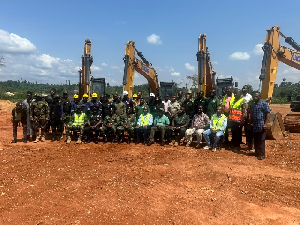
The Ghana Gold Board (GoldBod) and the Ghana Armed Forces (GAF) have successfully restored 50 hectares of land in the Tano-Nimiri Forest Reserve that had been ravaged by illegal mining, marking a significant milestone in the country’s efforts to reverse environmental damage caused by galamsey.
The military’s 14 Engineer Brigade carried out the first phase of the project and has since transferred the rehabilitated land to GoldBod, which is expected to pass it on to the Forestry Commission for replanting and lasting protection. The initiative falls under GoldBod’s Corporate Social Responsibility commitments and forms part of its broader National Reclamation and Environmental Restoration Programme.
A history of destruction
The Tano-Nimiri Forest Reserve, located in the Ashanti Region, has suffered extensive degradation from illegal mining over the years. Illegal mining contributed to the destruction of approximately 192.4 hectares of woodland in the area between 2021 and 2024, leaving behind deep mining pits, unstable terrain and disturbed soils. A major illegal mining invasion in 2022 seriously compromised biodiversity and timber concessions previously managed by Samatex Timber Company.
The reserve was selected as the first beneficiary of GoldBod’s national reclamation programme due to the extensive degradation of the forest. The initial phase focused on Compartment 161, where 50 hectares out of an estimated 200 hectares of degraded land were targeted for reclamation.
The reclamation effort
Speaking on behalf of GoldBod Chief Executive Officer Sammy Gyamfi, the Deputy Director of Mining Operations, James German, said the effort showed the board’s resolve to promote responsible mining and safeguard the environment. “Mining and environmental stewardship must no longer be treated as competing priorities. Responsible mining must support environmental restoration and deliver lasting benefits to the country,” he said.
The Commander of the 14 Engineer Brigade, Brigadier General Richard Kinney, revealed that his team found 10 large pits in Compartment 161, some as deep as 20 feet and stretching 30 to 50 metres across. Stagnant water had collected in them, and numerous smaller excavations dotted the area.
The work involved pumping out the water, backfilling the pits, contouring and grading the terrain to curb erosion, and reopening streams that illegal miners had blocked. Soldiers also removed the soggy mud, let it dry, and blended it with dry earth and topsoil to form a firm base. Major Shem Adolinama, who led the GAF Engineer Regiment team on the project, explained that despite the daunting task, the team successfully backfilled the extensive mining pits and prepared the site for reforestation.
Reaching the site proved difficult as well, since flooding earlier in the year had washed away eight bridges along the route. Brigadier General Kinney said the Brigade rebuilt all eight and cleared and lengthened most of the 13.6-kilometre access road so vehicles could reach the compartment again.
Financial commitment and long-term strategy
The project represents a total investment of approximately GH¢35 million. The civil engineering component cost GH¢27.9 million, paid to the Ghana Armed Forces Engineer Regiment, while the afforestation component, to be undertaken by the Forestry Commission, is projected to cost GH¢7.2 million over the next ten years, with GH¢2.2 million allocated for the first phase between 2026 and 2027.
GoldBod’s decision to partner with the Ghana Armed Forces was informed by the military’s reputation for integrity, discipline, patriotism and reliability. Sammy Gyamfi noted that reclamation projects have often been exploited as opportunities for further illegal mining activities, making it imperative to engage a trusted institution capable of safeguarding the project’s objectives.
Securing the gains
To prevent illegal miners from returning, the project has established a Forward Operating Base to house 10 Forestry Commission personnel. Built from 10 prefabricated containers, it has a borehole, solar power, washrooms, a kitchen, a shaded resting area and chain-link fencing.
Brigadier General Kinney warned that restoring the land would not, on its own, keep the forest safe. “Areas previously affected by illegal mining remain vulnerable to renewed encroachment. Without sustained presence, patrols and monitoring, the resources invested could be wasted,” he said.
German revealed that a 10-year agreement with the Forestry Commission has been put in place to guarantee continued restoration work and monitoring of the site. He said the project’s success would be judged not just by the area recovered, but also by how many planted trees survive, how stable the ground remains and how well the forest ecosystem rebounds. “Over time, this area must blend naturally with the surrounding forest,” he added.
A model for the future
The initiative has drawn praise from the highest levels of government. President John Dramani Mahama has commended GoldBod for engaging the Ghana Armed Forces to reclaim 253 acres of land destroyed by illegal mining activities in the Tano-Nimiri Forest. The government has also set aside GH¢200 million for the reclamation of 5,000 acres of degraded land, with work expected to begin next year.
GoldBod, established under Act 1140 of 2025, is mandated not only to regulate gold trading and maximise benefits from Ghana’s gold resources, but also to promote sustainable mining practices and environmental stewardship. The Tano-Nimiri project is seen as a pilot that could be replicated in other degraded mining areas across the country, where illegal mining has significantly degraded more than 4,000 hectares of land and affected 34 forest reserves across seven regions.
The Forestry Commission is expected to undertake reforestation activities as part of efforts to restore the degraded landscape and protect the forest’s ecological integrity, with GoldBod stating that the initiative forms part of broader efforts to reverse the environmental damage caused by illegal mining and safeguard Ghana’s natural resources for future generations.
Get the AfroAsia Media newsletter
The day's top stories from Africa and Asia, straight to your inbox.
Comments
0 comments
Loading…