
GHC2 Billion collected to clean Ghana — So why is Accra still this filthy?
A month after devastating floods submerged parts of Accra, killing several people and displacing thousands, JoyNews Explains set out to investigate a quieter but persistent culprit behind the crisis: the mountains of garbage choking the city’s markets, drains, lorry stations, and roadways. The evidence was everywhere—plastic wrappers clogging gutters, rotting food waste spilling onto pavements,…
Published 5 min read
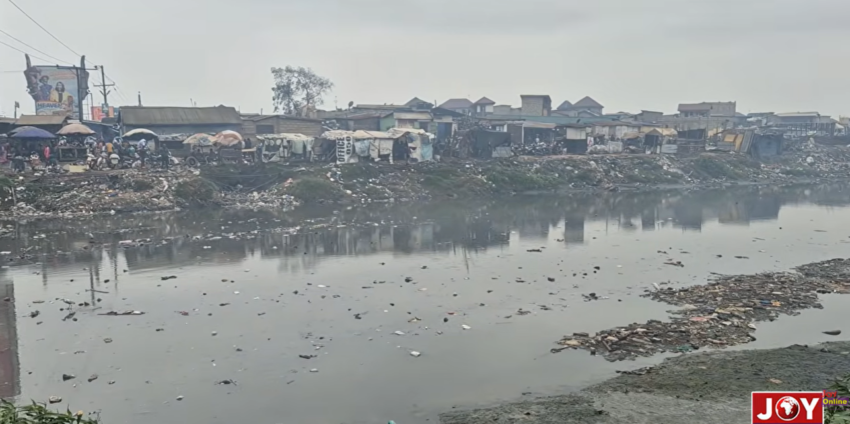
A month after devastating floods submerged parts of Accra, killing several people and displacing thousands, JoyNews Explains set out to investigate a quieter but persistent culprit behind the crisis: the mountains of garbage choking the city’s markets, drains, lorry stations, and roadways.
The evidence was everywhere—plastic wrappers clogging gutters, rotting food waste spilling onto pavements, and open piles of refuse festering in broad daylight. But this is not merely a story about litter. It is a story about GH¢2.03 billion—and where that money has, and has not, gone.
The Levy That Was Supposed to Clean Up
Since 2021, the government has collected GH¢2.03 billion through the Sanitation and Pollution Levy—a 10-pesewa charge on every litre of petrol and diesel sold in Ghana. The levy, introduced under the Energy Sector Levies Act, was explicitly designed to fund five core interventions:
· Improving air quality
· Building and upgrading waste treatment facilities
· Supporting landfill management
· Running fumigation and disinfection exercises
· Constructing sanitation facilities to eliminate open defecation
According to data from the Finance Ministry, GH¢1.51 billion of that total had been spent by the end of 2024. The breakdown, however, reveals a troubling picture:
· ~GH¢1.2 billion (80%) – spent on maintaining landfill sites and waste treatment facilities
· ~GH¢100 million – spent on improving air quality
· ~GH¢95.9 million – spent on fumigation and disinfection
· ~GH¢74.7 million – spent on waste treatment infrastructure
And then, there is a glaring zero: GH¢0 was spent on constructing sanitation facilities to eliminate open defecation—despite that being one of the levy’s stated core objectives.
The 2025 Collection – Still Unaccounted For
For 2025, the government collected an additional GH¢298 million. As of the end of 2024, the Sanitation and Pollution Account held a balance of GH¢180.5 million. Adding the 2025 collections suggests the account could now hold approximately GH¢478 million—assuming no further withdrawals have been made. However, the Finance Ministry has yet to publish an official breakdown of how the 2025 funds were utilised.
This leaves a critical question hanging: With nearly half a billion cedis sitting in a dedicated sanitation account, why do Accra’s streets still look like a dump?
The Post-Flood Clean-Up That Raised Legal Questions
In the wake of the June 2026 floods, President John Dramani Mahama declared July 10 and 11, 2026, as National General Cleaning Days across seven affected regions, urging citizens to participate in a mandatory clean-up exercise to prevent disease outbreaks.
But the directive immediately ran into legal headwinds. Samson Lardy Anyenini, a private legal practitioner, journalist, and host of Joy FM’s Newsfile, argued that compelling citizens to participate lacked any statutory backing. “Unless a specific assembly has a by-law mandating the exercise and a person is found in breach of it, forcing anyone to participate would be legally wrong,” Anyenini stated. The President’s directive, he noted, was an executive appeal, not a legally enforceable order.
Two Failures, Not One
What JoyNews Explains uncovered is a story with two distinct failures—only one of which costs money to fix.
Failure One: Institutional Accountability
Hundreds of millions of cedis were collected specifically to fund sanitation infrastructure, yet core objectives—most notably ending open defecation—received zero funding. Meanwhile, over 80% of the expenditure went to landfill maintenance, raising concerns about whether priorities were aligned with the levy’s original purpose. The lack of transparency around the 2025 collections only deepens the accountability deficit.
Failure Two: Civic Behaviour
Much of the filth captured by JoyNews cameras across Accra’s markets, drains, and streets was not the result of a funding gap. It was there because individuals chose the ground over a bin. That part costs nothing to fix—and requires no levy, no law, and no presidential directive. It demands only a change in personal responsibility.
As the report concluded: “It’s not one failure. It’s two. And only one of them costs money to correct.”
The Broader Context: Accra’s 66-Year Flooding History
This investigation is part of a broader JoyNews Explains series examining Accra’s chronic sanitation and flooding crisis. Previous episodes have traced the city’s 66-year history of devastating floods—dating back to independence—and documented the rampant encroachment on waterways and natural drainage channels that has turned seasonal rains into annual disasters.
Urban planning experts have long warned that without serious investment in waste collection, drainage maintenance, and public education, Accra’s filth problem will continue to amplify flood risks, disease outbreaks, and economic losses.
What Needs to Change?
Stakeholders are calling for:
- Full transparency on the Sanitation and Pollution Account, including a detailed audit of all 2025 expenditures.
- Ring-fencing of funds specifically for open defecation elimination and public toilet construction—not just landfill upkeep.
- Enhanced enforcement of existing sanitation by-laws, combined with public awareness campaigns to shift civic habits.
- Stronger legal clarity on presidential powers regarding mandatory clean-ups, to avoid future constitutional challenges.
A City at a Crossroads
Accra is not dirty because Ghana lacks money. It is dirty because the money has been spent unevenly, and because too many citizens still treat the streets as a dumping ground. As the rainy season intensifies, the cost of that dual failure will only rise—in lives lost, property destroyed, and public health compromised.
The question now is whether the government will act on the accountability gap, and whether Ghanaians will act on the behavioural gap. Because until both failures are addressed, the city’s drains will keep overflowing—and the filth will keep flowing.
Get the AfroAsia Media newsletter
The day's top stories from Africa and Asia, straight to your inbox.




Comments
0 comments
Loading…