
Ghana seeks US support for first state-owned nuclear power plant
Ghana is seeking financial, technical and institutional support from the United States to advance plans for its first nuclear power plant, as the government intensifies efforts to diversify the…
Journalist
Published 6 min read
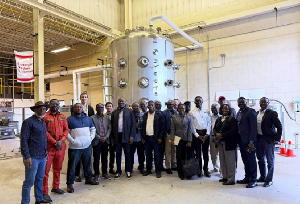
Ghana is seeking financial, technical and institutional support from the United States to advance plans for its first nuclear power plant, as the government intensifies efforts to diversify the country’s electricity generation mix and strengthen long-term energy security.
The latest push follows a five-day working visit to the United States by a Ghanaian delegation led by Deputy Minister for Energy and Green Transition, Richard Gyan-Mensah, who represented sector Minister John Abdulai Jinapor.
During the visit, the delegation held discussions with US government agencies, nuclear technology companies, the Nuclear Energy Institute and George Mason University on possible areas of cooperation.
Mr Gyan-Mensah said the engagements identified opportunities for American support, including grants for preliminary studies, project-development financing, investment guarantees, technical assistance and independent assessments of nuclear technologies being considered by Ghana.
The discussions also covered nuclear regulation, security, academic cooperation and professional training, with the aim of developing the expertise required for Ghanaians to participate in and eventually operate the country’s nuclear power industry.
The delegation’s visit follows an earlier diplomatic engagement in which Foreign Affairs Minister Samuel Okudzeto Ablakwa sought US cooperation on nuclear energy during a farewell meeting with the outgoing American ambassador.
Although the discussions have opened up possible areas of collaboration, no US financing package, investment guarantee or technology agreement has been formally announced.
US engagement comes ahead of US$200m programme
The American discussions form part of a broader government strategy to prepare Ghana for the construction of its first nuclear power plant.
Finance Minister Dr Cassiel Ato Forson announced in the 2027 Budget Statement that the government would invest US$200 million in a 24-month nuclear-readiness programme, scheduled to run from January 2027 to December 2028.
The programme is expected to address critical preparations, including the assessment of potential plant sites, selection of nuclear technology, environmental studies, financing arrangements, licensing, nuclear safeguards, emergency preparedness and safety requirements.
Government’s target is to complete the preparatory process by December 2028 and sign an engineering, procurement, construction and financing contract for a fully state-owned nuclear baseload power plant.
Dr Forson has, however, clarified that completing the readiness programme in 2028 would not mean the plant would begin generating electricity that year. Rather, it would put Ghana in a position to enter into a construction agreement.
The government intends to retain ownership of the facility, with international partners expected to provide technology, financing, engineering expertise and other specialised services.
More than 2,000 Ghanaian scientists are also expected to receive training to build the local technical capacity needed to support the programme.
Nsuban identified as preferred site
Ghana has made progress in identifying possible locations for the proposed nuclear facility.
Nsuban in the Western Region has been identified as the preferred site, while Obotan in the Central Region has been named as an alternative following technical assessments by Ghanaian experts.
The final selection will require further technical, environmental and safety evaluations as part of the country’s nuclear-readiness process.
The government is targeting the integration of nuclear-generated electricity into the national power mix by 2030. However, the completion of preparatory work and the signing of a construction contract should not be confused with the commissioning of an operational nuclear power plant.
Ghana’s nuclear ambitions date back to the 1960s
Ghana’s interest in nuclear energy is not new. The country’s nuclear journey dates back to the early 1960s, when the government of the country’s first President, Dr Kwame Nkrumah, initiated the Kwabenya Nuclear Reactor Project to promote nuclear science and its peaceful applications.
The ambition was to complement hydropower, particularly following the development of the Akosombo Dam, and provide an additional source of electricity to support industrialisation.
The programme slowed after the overthrow of Dr Nkrumah but was revived during subsequent administrations, particularly following electricity supply challenges in the 2000s.
Ghana has since established key institutions to oversee the development and regulation of its nuclear power ambitions.
These include the Nuclear Regulatory Authority (NRA), which is responsible for regulating nuclear and radiological activities; Nuclear Power Ghana, the designated owner-operator; and the Nuclear Power Institute, which provides technical expertise and support.
The Ghana Nuclear Power Programme Organisation coordinates the work of government agencies, private-sector institutions, academia and other stakeholders involved in the programme.
In August 2022, Ghana officially transitioned into Phase Two of the International Atomic Energy Agency’s (IAEA) milestone approach to developing nuclear power infrastructure. This phase involves preparatory work after a country has taken a policy decision to pursue nuclear energy.
Existing US-Ghana nuclear cooperation
The latest discussions build on an established relationship between Ghanaian nuclear institutions and American regulatory and technical bodies.
According to the Nuclear Regulatory Authority, Ghana and the United States have maintained bilateral cooperation on nuclear safety matters, including a technical information exchange arrangement with the US Nuclear Regulatory Commission signed in September 2017.
The NRA has also received assistance from the US Department of Energy in areas including nuclear security and safeguards.
In 2025, the authority undertook a project with the US Nuclear Regulatory Commission to provide practical training for its staff in reviewing and assessing nuclear safety reports, including material relating to the NuScale small modular reactor design.
Such cooperation is important because introducing nuclear power requires more than selecting a reactor supplier. A country must establish an independent regulatory system, develop qualified personnel, put in place security and emergency-response arrangements, and demonstrate that it can safely manage nuclear facilities and radioactive waste.
Russia also in discussions with Ghana
The search for international partners is not limited to the United States.
President John Dramani Mahama announced in October 2026 that Ghana had initiated discussions with Russia’s State Nuclear Energy Corporation, Rosatom, over the establishment of the country’s first nuclear power station.
Russia has offered assistance towards a proposed 2,000-megawatt nuclear plant.
The engagement with Washington therefore adds another potential international partner to Ghana’s nuclear development discussions, as the country considers technology options, financing arrangements and the expertise required to deliver the project.
The government has not yet announced a final technology provider or concluded a construction agreement.
Energy security, costs and safety considerations
The proposed nuclear plant is expected to provide baseload electricity — a steady supply of power capable of operating around the clock — to complement generation from hydroelectric and thermal sources.
Nuclear energy is being considered as part of a wider effort to improve electricity reliability, support industrial growth and reduce the country’s exposure to fluctuations in fuel prices and the cost of thermal power generation.
The 2027 Budget also outlines plans for a fully state-owned 600-megawatt solar plant supported by 2,000 megawatt-hours of battery storage, as well as a 1,450-megawatt thermal power plant.
Government says the wider energy investments are intended to support the phase-out of emergency power plants by December 2030.
However, Ghana’s nuclear ambitions will depend on its ability to address substantial financial, technical, regulatory and environmental requirements. Nuclear power projects typically require significant upfront capital, long construction periods and sustained institutional oversight.
Safety, radioactive waste management, nuclear security, environmental protection and public confidence will therefore remain central to the process.
The IAEA’s framework for introducing nuclear power identifies 19 infrastructure issues countries must address, covering areas such as funding, legislation, regulatory independence, human-resource development, emergency planning, site selection, waste management and procurement.
For Ghana, the immediate task is to complete the preparatory work, secure credible international partnerships and establish the institutional and financial arrangements necessary to move from policy ambition to construction.
The proposed US engagement could contribute to that process, but the scale of American assistance and the eventual terms of cooperation remain to be determined.
Get the AfroAsia Media newsletter
The day's top stories from Africa and Asia, straight to your inbox.
Comments
0 comments
Loading…