
China ready to support Ghana’s US$10bn New Economy Programme – Ambassador
China has expressed its readiness to support Ghana’s ambitious US$10 billion New Economy Programme through technology transfer, industrial partnerships and investment cooperation in strategic…
Journalist
Published 6 min read
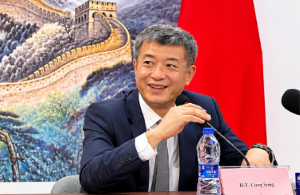
China has expressed its readiness to support Ghana’s ambitious US$10 billion New Economy Programme through technology transfer, industrial partnerships and investment cooperation in strategic sectors, including artificial intelligence (AI), green technology, agriculture, mining and energy.
Chinese Ambassador to Ghana, Cong Song, said China was prepared to share its industrialisation experience, provide technological expertise and work with Ghanaian institutions and businesses to strengthen local production capacity, develop technical skills and accelerate economic transformation.
He said the two countries had significant opportunities to deepen bilateral cooperation in emerging technologies and high-growth industries, particularly as Ghana seeks to move beyond dependence on raw material exports towards manufacturing, innovation and value addition.
Mr Cong made the remarks at a press briefing in Accra on Monday, November 16, 2026, during which he discussed the outcomes of the Fifth Plenary Session of the 20th Central Committee of the Communist Party of China, held in Beijing from October 26 to 29.
Responding to questions about China’s potential contribution to Ghana’s New Economy Programme, the Ambassador proposed aligning China’s 15th Five-Year Plan with Ghana’s 24-Hour+ Economy and the government’s Reset Ghana Agenda to identify areas of common interest and advance mutually beneficial development initiatives.
He identified artificial intelligence, green technology, industrial upgrading, sustainable agriculture and environmentally responsible mining as sectors offering considerable opportunities for collaboration.
“There is considerable potential for cooperation between China and Ghana in areas such as talent training, smart healthcare and many other areas,” he said.
US$10bn programme to transform Ghana’s economy
China’s offer comes at a time Ghana is preparing to implement its US$10 billion New Economy Programme, a four-year economic transformation initiative announced by Finance Minister Dr Cassiel Ato Forson during the presentation of the 2027 Budget Statement and Economic Policy to Parliament on November 12.
The programme, scheduled to run from 2027 to 2030, is expected to attract an average investment of US$2.5 billion annually, with the government allocating GH¢30 billion, equivalent to 1.5 per cent of GDP, towards its implementation in 2027.
It is designed to expand domestic production, strengthen industrial capacity, increase exports, create employment and position the private sector as the principal driver of economic growth.
The initiative is anchored on eight priority areas: commercial agriculture; energy infrastructure; value addition in critical minerals; tourism, culture and creative arts; textiles and garments; pharmaceuticals and biomanufacturing; the technology economy; and macroeconomic stability and affordable financing.
Under the agricultural component, government plans to invest in strategic value chains, including rice, sugar, poultry, maize, soya, aquaculture, oil palm and cocoa processing.
The energy component will focus on expanding electricity generation, improving transmission infrastructure and reducing the cost of power to support industrial growth.
In the mining sector, the programme seeks to end the longstanding practice of exporting raw minerals without sufficient domestic processing by promoting local refining and value addition in gold, manganese and bauxite.
The government also intends to strengthen Ghana’s pharmaceutical and textile industries while developing tourism and the creative arts as additional sources of foreign exchange and employment.
AI, technology and skills development
Mr Cong identified Ghana’s National Artificial Intelligence Strategy and the One Million Coders Programme as important platforms for cooperation between the two countries.
He said China could support Ghana through technical training, knowledge sharing, technology transfer and innovation partnerships to develop the human resources required to compete in the digital economy.
China’s experience in artificial intelligence, electric vehicles, robotics and advanced manufacturing, he added, could provide useful lessons for Ghana as it pursues industrialisation and modernisation.
According to figures cited by the Ambassador, China’s AI industry was valued at more than 1.2 trillion yuan in 2025, representing an annual growth of approximately 40 per cent. The country also had more than 6,600 AI enterprises, accounting for about 15 per cent of the global total.
He said sustained investment in research, innovation and technological development had been instrumental in China’s emergence as a major global manufacturing and technology power.
China eyes deeper electric vehicle cooperation
The Ambassador also highlighted opportunities for Ghana to benefit from China’s growing electric vehicle industry.
China produced approximately 16.6 million new energy vehicles and sold nearly 16.5 million units in 2025, maintaining its position as the world’s largest producer and market for electric vehicles for the 11th consecutive year.
He encouraged Chinese electric vehicle manufacturers operating in Ghana to move beyond importing and selling vehicles to investing in local maintenance facilities, technical training and skills development.
He said partnerships between Chinese companies and Ghanaian technical institutions could help establish specialised training programmes and research facilities to prepare young people for emerging opportunities in the electric mobility industry.
He cited ongoing discussions between Chinese enterprises and educational institutions, including Kumasi Technical Institute, on possible cooperation in electric vehicle training and technical skills development.
Such partnerships, he suggested, could help Ghana build the technical expertise needed to support the maintenance, servicing and eventual development of electric mobility technologies locally.
China pushes local mineral processing
On mining, Mr Cong called for a shift in Ghana-China cooperation from the extraction and export of raw materials towards local processing, industrial development and value addition.
He maintained that Africa’s mineral resources should deliver greater economic benefits to its people, stressing that partnerships must be guided by mutual benefits, sustainable investment and respect for national development priorities.
He said Chinese companies were being encouraged to introduce environmentally friendly technologies, establish local processing facilities and train Ghanaian workers.
The approach aligns with Ghana’s ambition to maximise revenue from its mineral resources by developing domestic industries capable of processing gold, manganese, bauxite and other critical minerals before they are exported.
For Ghana, stronger cooperation in this area could create opportunities for technology transfer, employment, industrial expansion and increased export earnings.
China highlights zero-tariff opportunities for Ghana
The Ambassador also drew attention to China’s zero-tariff policy for African countries, describing it as an opportunity to increase African exports to the Chinese market and attract more Chinese investment into African economies.
He said Ghanaian agricultural products, cocoa, handicrafts and mineral products could benefit from improved access to the Chinese market.
However, he stressed that the broader objective should go beyond exporting commodities to encouraging Chinese businesses to establish operations in Ghana, process raw materials locally and create employment.
China’s interest in expanding economic cooperation with Ghana also builds on the longstanding diplomatic and commercial relationship between the two countries.
Mr Cong recalled the October 2025 meeting between Chinese President Xi Jinping and President John Dramani Mahama in Beijing, describing the discussions as an important framework for strengthening bilateral relations and advancing economic cooperation.
He reaffirmed China’s commitment to working with Ghana to implement the consensus reached by the two leaders and identify development priorities that could benefit both countries.
Opportunity for Ghana’s industrial transformation
China’s readiness to support the New Economy Programme presents an opportunity for Ghana to attract technical expertise, industrial partnerships and investment as it seeks to transform its economy.
China has emerged as a major global manufacturing centre through sustained investments in infrastructure, research, technology, industrial production and skills development.
For Ghana, the potential benefits could include stronger manufacturing capacity, improved agricultural productivity, expanded mineral processing, technology-driven businesses and new employment opportunities for young people.
However, the Ambassador’s remarks represent an expression of China’s willingness to cooperate in strategic sectors and should not be interpreted as a confirmed US$10 billion Chinese financing commitment.
Specific projects, financing arrangements, investment commitments and implementation agreements are yet to be announced.
The success of any partnership will ultimately depend on how effectively Ghana translates the diplomatic assurances into concrete investments, technology transfer, local industrial capacity and measurable economic benefits.
As government prepares to roll out the New Economy Programme in 2027, cooperation with China could become an important component of efforts to move Ghana towards a more productive, industrialised and export-oriented economy.
Get the AfroAsia Media newsletter
The day's top stories from Africa and Asia, straight to your inbox.
Comments
0 comments
Loading…